
Contents
TL;DR
- Your ICP definition is not an account list. Build a named list of 10 to 20 companies before you post another word.
- Content posted without account architecture goes to your existing audience. Not to the companies you want to close.
- The 95-5 rule: only 5% of target accounts are in-market at any time. ABM is how you become the known name for the other 95%.
- The Founder ABM Stack runs on four layers: account architecture, account-signal content, strategic engagement, and engagement-triggered outreach.
- No sales software required. A spreadsheet, a LinkedIn account, and the discipline to apply them to a named list.
What ABM on LinkedIn Means
You have been posting consistently for six months. Your content gets engagement. Follower count moves. And you have had exactly zero inbound conversations from the twenty companies you actually want as clients.
This is not a content quality problem. It is a targeting architecture problem. ABM is the fix.
ABM (account-based marketing) is not a technology category. It is a precision mindset. Stop broadcasting to everyone. Start building deliberate visibility with the specific companies you most want to work with.
ABM on LinkedIn is a targeted growth strategy where a founder or B2B company focuses their content, engagement, and outreach on a defined list of high-value accounts, rather than broadcasting to a general audience, with the goal of building familiarity, trust, and pipeline with the specific companies most likely to become customers.
No Demandbase required. No 6sense licence. No Terminus contract. Those platforms serve enterprise teams with the budget and headcount to run them. This article is not about them.
The structural logic behind all of it comes from what the LinkedIn B2B Institute and Ehrenberg-Bass Institute call the 95-5 rule.
At any given moment, only 5% of your target accounts are actively in-market. The other 95% are not shopping yet. When they enter the market, they choose the name they already know. ABM is the system for becoming that name.
What follows is The Founder ABM Stack: a four-layer framework that runs on a spreadsheet, a LinkedIn account, and a content strategy.
Why Consistent Posting Fails to Generate Target Account Pipeline
Most founders who have been on LinkedIn for six to twelve months know the pattern. Post consistently. Generate engagement. Watch content perform reasonably well. See nothing from the specific companies they most want to close.
The instinct is to blame the content. Better hooks. Sharper angles. More value.
The content is not the problem. The architecture is.
When a founder posts without a named account list in place, content reaches their existing audience: former colleagues, adjacent professionals, general scrollers. Useful. But they're not the decision-makers at the twenty accounts that matter.
This is the structural difference between lead generation and ABM:
.ss-tbl-wrap{overflow-x:auto;margin:1.5em 0}.ss-tbl{width:100%;border-collapse:collapse;font-size:.95rem;line-height:1.5;color:inherit}.ss-tbl th,.ss-tbl td{border:1px solid rgba(128,128,128,.28);padding:.7em 1em;text-align:left;vertical-align:top}.ss-tbl thead th{font-weight:600;background:rgba(128,128,128,.1)}.ss-tbl tbody td:first-child{font-weight:500}Lead GenerationABMOptimises for volume of individualsOptimises for depth of engagement with named accountsSuccess = MQL countSuccess = pipeline from target accountsBroadcast content to the largest possible audiencePrecision content aligned to named account challengesOutreach to individuals who raise their handRelationship-building across the full buying group
Lead generation asks: how many people can I reach?
ABM asks: how deeply can I embed my name inside the specific companies I want to work with?
The 95-5 rule makes the stakes concrete. Only 5% of target accounts are in-market at any given moment. Broadcast content does nothing for the other 95%. It does not build familiarity. It does not create the mental availability that determines which name gets called when the buying window finally opens.
The fix is not more content. It is account architecture first. Then content and engagement aligned to that architecture.
Why Founder-Led Content Is the Most Effective ABM Channel on LinkedIn
One premise shapes every tactical decision in this stack.
The founder's personal LinkedIn presence is the primary instrument in a founder-led ABM motion. Not the company page. Not ad spend. This is not a LinkedIn marketing opinion. It is what B2B decision-makers report about how they actually make buying decisions.
The 2024 Edelman-LinkedIn B2B Thought Leadership Impact Report, surveying 3,484 professionals across seven countries, found:
- 73% of B2B decision-makers find thought leadership more trustworthy than marketing materials when assessing a company's capabilities.
- 9 in 10 executives say they would be more receptive to outreach from a company that consistently produces quality thought leadership.
- 52% of decision-makers and 54% of C-suite executives spend one hour or more per week consuming thought leadership.
The finding that rarely makes it into ABM conversations is that 63% of hidden buyers (finance, legal, procurement contacts who influence decisions but rarely appear in outreach sequences) also spend one hour or more per week consuming thought leadership.
These are the people who kill deals. Thought leadership reaches them in a way targeted outreach cannot.
The ad performance data tells the same structural story. The ZenABM 2026 LinkedIn ABM Benchmarks report, drawn from 161,256 ads across 211 companies, found Thought Leader Ads from a founder's profile deliver a 2.68% median CTR versus 0.42% for standard single-image ads (a 6.4x gap), at $2.29 cost per click versus $13.23.
The format attached to a person outperforms the format attached to a brand by a significant margin. The company page reinforces credibility, but it is not the trust vehicle. The founder is.
How to Build a Target Account List for LinkedIn ABM
The Founder ABM Stack runs on four layers. Each one depends on the one before it.
Layer 1: Build Your Named Account List Before You Post
Here is the skip almost every founder makes.
They define their ICP. They know the industry, company size, the titles they are selling to. They feel ready to post. So they do.
An ICP definition is not an account list. "B2B SaaS companies with 50 to 200 employees led by a growth-focused founder" is a demographic filter. It describes the pond. It is not a list of fish.
ABM cannot function without named accounts.
How to build your account architecture:
- Define ICP criteria beyond demographics. Add trigger events: recent funding, new leadership hire, market expansion, hiring patterns in specific functions. These signal an active or imminent buying cycle.
- Build a named list. Company names, not categories. Specific organisations, specifically chosen.
- Map decision-maker roles at each account. Who buys. Who influences. Who blocks. Most B2B purchases involve three to five people. Most founders are only trying to reach one of them.
- Monitor their LinkedIn activity. What problems are decision-makers at these accounts publicly naming? What content are they engaging with? This is a free signal map.
- Tier and prioritise by revenue potential and relationship proximity.
The three-tier structure:
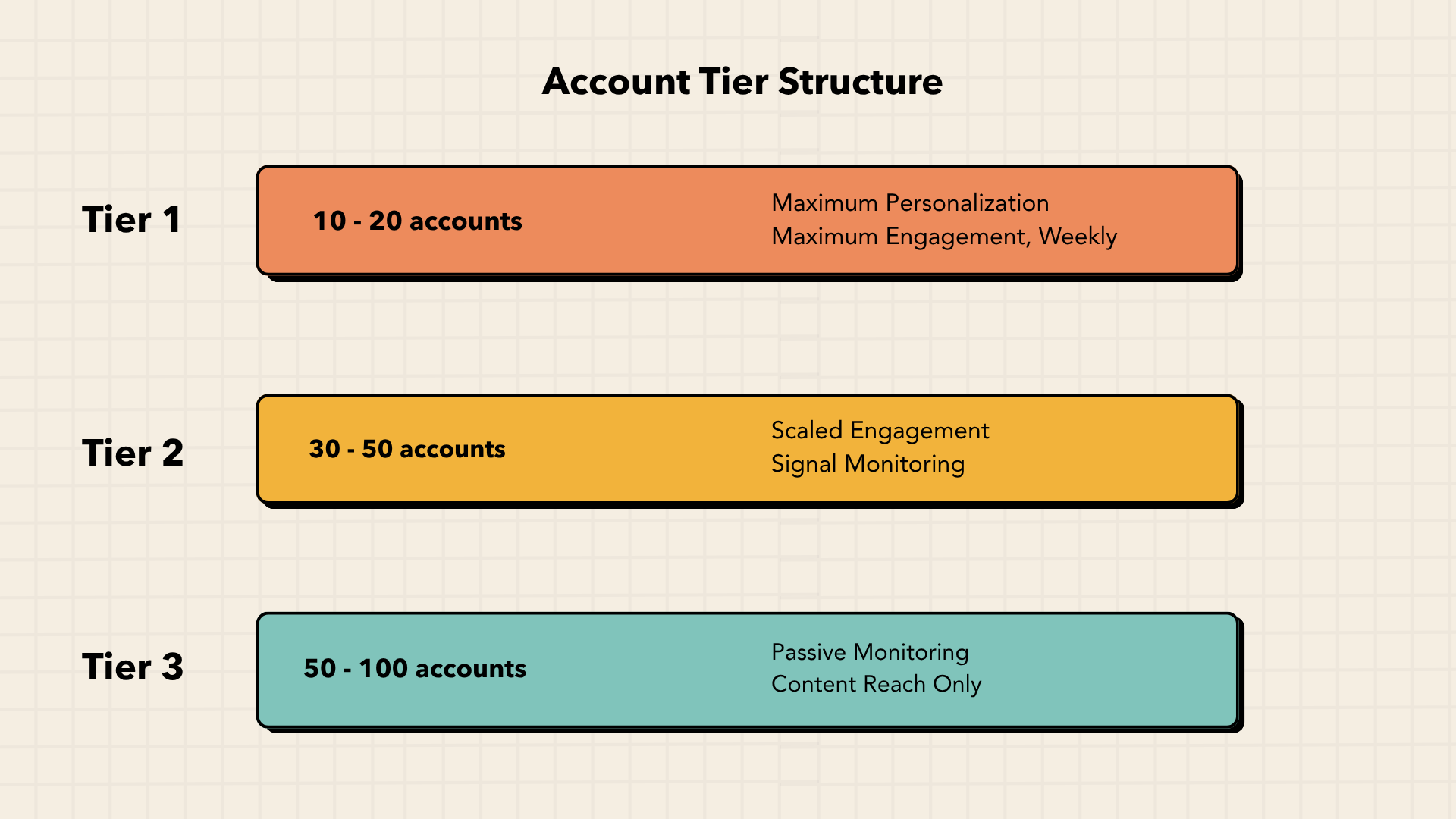
Start with ten Tier 1 accounts. Ten. Build the architecture around those ten companies before expanding. A focused list of ten produces better results than a sprawling list that gets ignored.
Founders who build account architecture before posting consistently report their first warm inbound conversations from target accounts within 60 to 90 days, and first meetings from named accounts within 90 to 120 days.
Does LinkedIn ABM Require Sales Navigator?
Sales Navigator is not required to run Tier 1 ABM. Standard LinkedIn search plus a spreadsheet covers account identification, decision-maker mapping, and engagement tracking for up to 20 named accounts. Sales Navigator earns its place at Tier 2 and above, when monitoring 50 or more accounts manually becomes unworkable. For founders starting with 10 Tier 1 accounts, it is a premature cost.
Layer 2: Write Content That Signals to Your Target Accounts
With an account list in place, the content question changes.
Most founders ask: what does my audience want to read? This is the right question for building a following. It is the wrong question for an ABM motion.
The ABM question is: what do the specific challenges my Tier 1 accounts face look like when articulated precisely, and can I articulate them better than they can themselves?
Content in an ABM motion is not broadcast media. It is a precision signal. When a decision-maker encounters a post that names their exact problem in language that feels uncomfortably specific, that is the moment familiarity is built. Not an impression. Recognition.
.ss-tbl-wrap{overflow-x:auto;margin:1.5em 0}.ss-tbl{width:100%;border-collapse:collapse;font-size:.95rem;line-height:1.5;color:inherit}.ss-tbl th,.ss-tbl td{border:1px solid rgba(128,128,128,.28);padding:.7em 1em;text-align:left;vertical-align:top}.ss-tbl thead th{font-weight:600;background:rgba(128,128,128,.1)}.ss-tbl tbody td:first-child{font-weight:500}Broadcast ContentAccount-Signal Content"5 reasons B2B companies struggle with X""The exact moment scaling SaaS founders realise their outbound motion has broken""Why LinkedIn matters for your business""What founders building their first enterprise pipeline get wrong in the first 90 days"Optimised for reach and engagement rateOptimised for recognition among a named account list
Account-signal content does two things.
- It attracts organic engagement from people experiencing the named challenge.
- It seeds familiarity inside target accounts when decision-makers encounter it.
75% of B2B decision-makers told Edelman that thought leadership led them to research a product they were not previously considering. That mechanism only activates when the content is specific enough to feel relevant.
A founder with a Tier 1 account list can reverse-engineer their entire content calendar from what those accounts are publicly discussing. Their posts, comments, and job postings are a signal map. What they name publicly is a reliable indicator of what they would pay to solve.
One optional amplification layer: Thought Leader Ads from the founder's profile can seed this content directly to decision-makers at target accounts. This is where paid LinkedIn becomes precision-useful as an accelerant for the organic motion, not a substitute for it.
Layer 3: Use Strategic Engagement to Build Warmth Before Outreach
Every article on ABM on LinkedIn covers account lists, content strategy, and outreach sequences. Almost none of them cover this.
Strategic engagement means commenting substantively on posts from decision-makers at target accounts. Not reacting. Not sharing. Commenting with a specific observation, a named nuance, or an extension of the argument that adds something the original post did not contain.
The mechanism: when a founder comments thoughtfully on a decision-maker's post, that person receives a notification. They see the name. If the comment adds something, they read it.
This happens once, it's a weak signal. It happens five times over three weeks and the founder is no longer a stranger. It happens ten times over two months and the founder is a familiar name whose perspective is worth reading.
The cold start problem is already solved before any outreach begins.
.ss-tbl-wrap{overflow-x:auto;margin:1.5em 0}.ss-tbl{width:100%;border-collapse:collapse;font-size:.95rem;line-height:1.5;color:inherit}.ss-tbl th,.ss-tbl td{border:1px solid rgba(128,128,128,.28);padding:.7em 1em;text-align:left;vertical-align:top}.ss-tbl thead th{font-weight:600;background:rgba(128,128,128,.1)}.ss-tbl tbody td:first-child{font-weight:500}Generic CommentSubstantive Comment"Great post, thanks for sharing!"Adds a specific example or extends the argument with a related observation"Completely agree"Agrees and explains exactly why, with reference to a specific scenarioEmoji + one sentenceA short paragraph the original poster would find worth reading
Check Tier 1 account contacts' LinkedIn activity once or twice per week. Consistent enough to build familiarity. Deliberate enough to stay relevant.
This is relationship infrastructure. It is not outreach. Layer 4 is outreach.
SuperStrat Labs builds this system for founders who are serious about LinkedIn as a pipeline channel. If the account architecture, content strategy, and engagement motion are the missing pieces, a strategy call is the next step.
Layer 4: Send Outreach Triggered by Engagement, Not a Calendar
Cold outreach fails at the first step, when the prospect has no reason to trust the sender.
Every tactic designed to warm up cold outreach (the three-touch sequence, the mutual connection name-drop, the personalized first line) exists because the fundamental problem has not been solved. These tactics mitigate it. They do not eliminate it.
Layers 2 and 3 eliminate it. By the time Layer 4 begins, the founder is not a stranger.
The trigger is engagement. When a decision-maker at a Tier 1 or Tier 2 account comments on the founder's content, shares a post, or responds to a comment the founder left on theirs, that is the signal. Not to pitch, but to extend the conversation that has already started.
The first message is short. It references the specific content or interaction that prompted it. It asks a genuine question or offers something directly relevant to what the person has been publicly discussing.
"I noticed your comment on [specific post]. You named the exact challenge we have been seeing across a few clients in [their space]. Curious whether [specific issue] is something your team is navigating too, or whether it sits further upstream."
Short. Specific. Rooted in something real. No pitch.
Expandi's H1 2026 State of LinkedIn Outreach, drawn from over 20 million outreach attempts, found LinkedIn message reply rates average 10.3% compared to cold email's 5.1%.
For outreach that follows genuine content engagement, practitioners consistently report directionally higher rates. No single independently verified benchmark exists for this segment, but the logic holds: recognition plus relevance plus timing produces a fundamentally different response than cold contact.
This motion works because the founder is the content channel. A company page cannot create this warmth. An SDR running sequences on behalf of a brand the prospect has never encountered cannot create it either.
How Long LinkedIn ABM Takes and What Results to Expect
The honest answer: longer than paid, and compounding in a way paid never will be.
- 30 to 60 days: Profile views from Tier 1 accounts. Content engagement from named decision-makers. Early signals that the architecture is working.
- 60 to 90 days: Warm DM conversations beginning. Decision-makers who have seen the founder's content multiple times start responding to outreach or reaching out directly.
- 90 to 120 days and beyond: Pipeline-attributable outcomes. Meetings with named accounts. Inbound conversations that reference specific content as the reason for reaching out.
For paid ABM, signals arrive earlier. The organic motion takes longer to build momentum. It does not stop compounding once it starts. Paid campaigns stop the moment spend stops.
Across multiple independent B2B practitioner benchmarks, organic LinkedIn thought leadership runs 3 to 6 months to early pipeline signals and 6 to 12 months to sustainable pipeline generation. Longer than most founders want to hear. Also what a compounding authority asset looks like.
What to track:
Profile views from Tier 1 accounts. Comments from decision-makers at named targets. Warm DM conversations that reference specific content. First meetings with people who say they have been following the founder's posts.
What Metrics Should You Track for LinkedIn ABM?
- Profile views from Tier 1 accounts
- Comments and reactions from named decision-makers
- Warm DM conversations that reference specific content
- First meetings where the prospect mentions following your posts
Impressions, follower count, and post engagement rate are not ABM metrics. A post that reaches 50,000 people but generates zero movement inside your 20 target accounts has underperformed a post that reaches 2,000 people and prompts three Tier 1 decision-makers to comment.
How the Four Layers Work Together as a Complete System
The four layers are not independent tactics. Each one makes the next one possible.
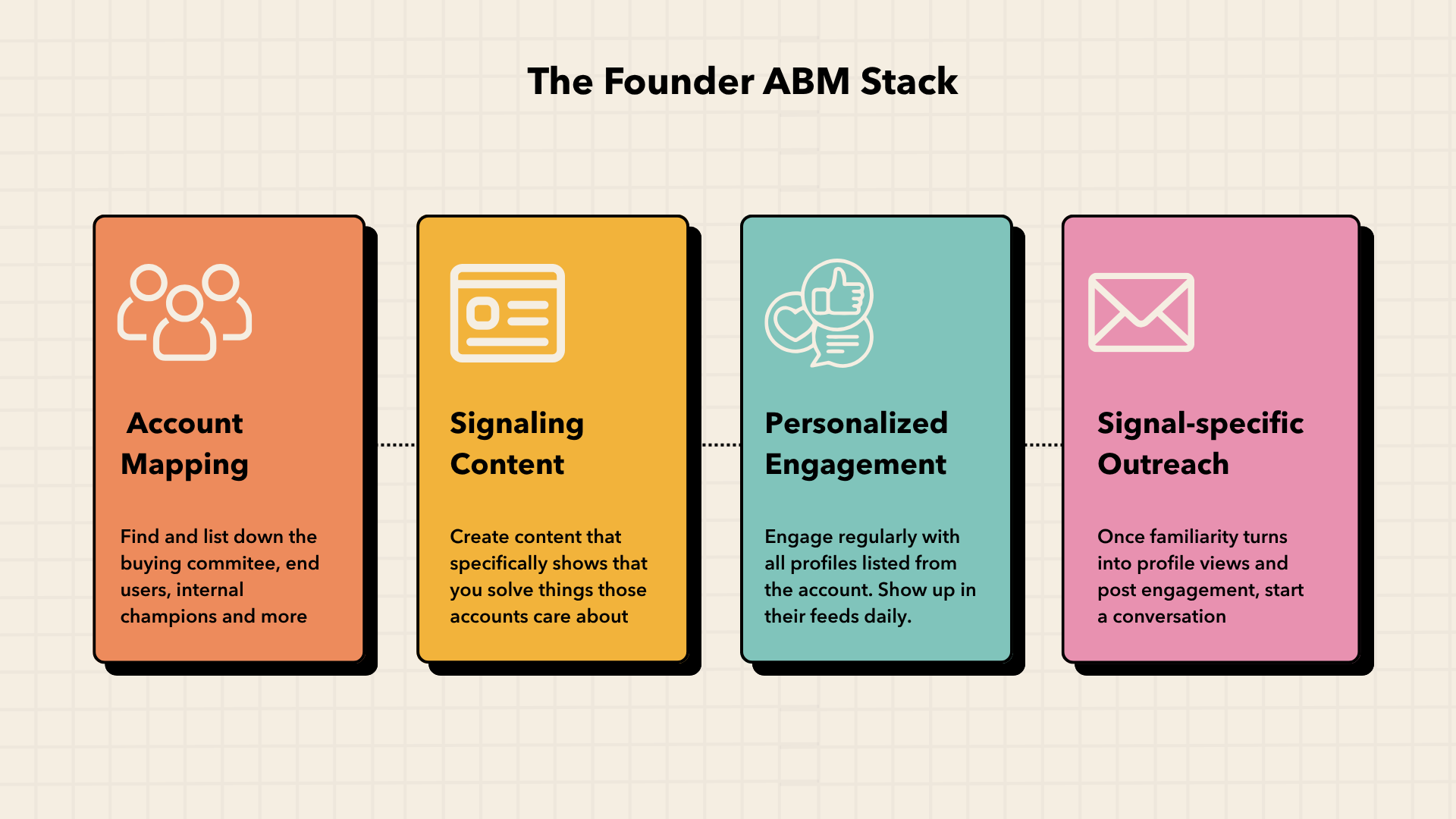
Account architecture gives content its target. Without a named list, content is broadcast. With it, content is a precision signal aimed at the specific challenges the people on that list are publicly navigating.
Content builds familiarity at scale. Posting consistently about the problems Tier 1 accounts face makes the founder a recognisable voice in conversations those accounts are already having. Before outreach begins.
Strategic engagement builds familiarity at the individual level. Decision-makers who have seen the founder's name in their notifications repeatedly are no longer strangers. The cold start problem is solved before Layer 4 is needed.
Engagement-triggered outreach converts that warmth into conversation. A message sent to someone who already knows the founder's name, has read their content, and has had their own ideas engaged with. That is not cold outreach. It is a continuation of a relationship the stack built.
A founder running this motion consistently for 90 days has:
- A named account list actively updating based on engagement signals
- Content built around the exact challenges their Tier 1 accounts face publicly
- Name recognition with decision-makers across 15 to 20 Tier 1 accounts
- Two to four warm conversations already started
No six-figure tech stack. No dedicated team. The founder's LinkedIn presence, aligned to an account architecture, is the system.
This is not a sprint. It is a compounding motion. The founders who commit to the architecture before the returns arrive are the ones who see them.
The account list is not built. The content is not converting. The outreach sequence does not exist. That is exactly what SuperStrat Labs builds. Book a strategy call.
Frequently Asked Questions
Check Tier 1 account contacts' activity once or twice per week and comment where there is something substantive to add. Consistency matters more than frequency. Showing up with a genuine observation every week outperforms daily reactions that add nothing.
Credibility reinforcement, not trust-building. When a decision-maker encounters the founder's content and checks the company page, it should confirm what the founder's profile already established. The company page does not drive the ABM motion. The founder does.
A spreadsheet with three columns per named account: engagement signals received, outreach sent, and conversation status. Update it once a week. The metrics that matter are profile views from Tier 1 accounts, comments from named decision-makers, and warm conversations in progress. None of that requires a CRM.
Reference the specific post or comment that prompted the message. Ask a genuine question about the problem they publicly named. Keep it to two or three sentences. The goal is to extend a conversation that has already started, not open a sales sequence.
Engagement is the signal. When a decision-maker at a target account comments on your content, shares a post, or responds to a comment you left on theirs, the cold start problem is already solved. That interaction is the trigger. Outreach sent before any engagement has occurred is still cold outreach, regardless of how personalised the first line is.
Start with ten Tier 1 accounts. The constraint is intentional. A focused list of ten forces the precision that makes ABM work. Expanding before the architecture is proven produces a sprawling list that gets ignored rather than worked.
Ready to start?
Turn your LinkedIn into a pipeline engine
SuperStrat works with a small number of B2B founders at a time. See if you’re a fit.
Book a Call →