Contents
TL;DR
- Your LinkedIn profile is a GTM asset, not a personal branding exercise. Most founders and executives are treating it like the latter, and it is costing them pipeline they do not even know they are missing.
- LinkedIn is a search engine with over 1 billion members. Buyers, investors, and partners are actively searching for people like you every day. If your profile does not have the right keywords, the right structure, and the right positioning, you simply do not show up.
- Every section of your profile is either working for you or against you. Your headline needs to do positioning, not just identification. Your About section needs to open with a conviction, not a career summary.
- Since LinkedIn's 2026 algorithm update, your profile and your content strategy are the same decision. Misalignment between what your profile claims and what you post actively suppresses your reach.
There is a version of this article that tells you to use a professional headshot and write a compelling summary.
This is not that article.
You already know your profile needs work. You have known for a while. The problem is not awareness. It is that every guide you have read treats LinkedIn profile optimization like a personal branding exercise: refresh the photo, polish the headline, add some keywords, feel better about yourself.
What none of those guides tell you is that a well-optimized profile is not supposed to make you feel better. It is supposed to make your buyers, partners, and investors find you — and take you seriously when they do.
That is the difference between a branding exercise and a GTM asset.
Most founders and executives have a LinkedIn profile that reads like a job application from five years ago. Title, company, a list of previous roles, and a generic summary that opens with "results-driven leader with 15 years of experience." Meanwhile their actual credibility sits somewhere completely separate. The deals closed, the markets entered, the companies built. None of it is visible. All of it doing nothing.
Here is the thing most executives do not realize: LinkedIn is also a search engine. Every week, buyers search LinkedIn for vendors, advisors, co-founders, and experts. If your profile is not built for both the visitor who arrives and the algorithm that decides whether they find you, you are invisible on both fronts.
This article covers both. Here is how to build a profile that ranks and converts.
Why Most LinkedIn Profiles Fail at Thought Leadership
Before you touch a single field, you need to change what you are optimizing for.
Most people build their LinkedIn profile as a credibility document, something that makes them look good to a broad professional audience. That approach produces vague, inoffensive profiles that impress nobody in particular because they are aimed at everyone in general.
A thought leadership profile has a fundamentally different job. It is not trying to impress everyone who visits. It is trying to be immediately and specifically relevant to one type of person: the exact buyer, investor, partner, or peer you need to reach.
Here is the clearest way to see the difference:
| CV profile | GTM profile | |
|---|---|---|
| Written for | The person who has it | The person about to visit it |
| Says | Here is my career and where I have worked | Here is the problem I solve and why you should care |
| Optimized for | Looking credible to everyone | Being immediately relevant to one specific person |
| Result | Views with no follow-through | Right people reaching out with intent |
That shift changes every section of your profile. Every word earns its place only if it answers one question:
“Why should the person I am trying to reach care about this?”
Before you rewrite anything, answer this first. Who are you trying to attract? Not in a vague "B2B decision-makers" way. Specifically.
- Early-stage founders validating a product?
- Enterprise procurement heads in logistics?
- VCs looking for portfolio companies with GTM traction?
- CMOs at scaling SaaS businesses?
The more specific your answer, the sharper every section of your profile becomes.
How LinkedIn SEO Works and Why It Affects Your Thought Leadership
Here is the part most executives skip entirely, and it is the reason a well-written profile still goes undiscovered.
LinkedIn is a search engine. Every day, buyers, investors, journalists, and partners search the platform for people with specific expertise. If your profile does not contain the language they are searching for, you simply do not appear in their results — regardless of how well-written your About section is.
How LinkedIn's algorithm ranks profiles:
LinkedIn scans your headline, About section, job titles, and skills to match them with the keywords people type into the search bar. It then ranks profiles using four signals:
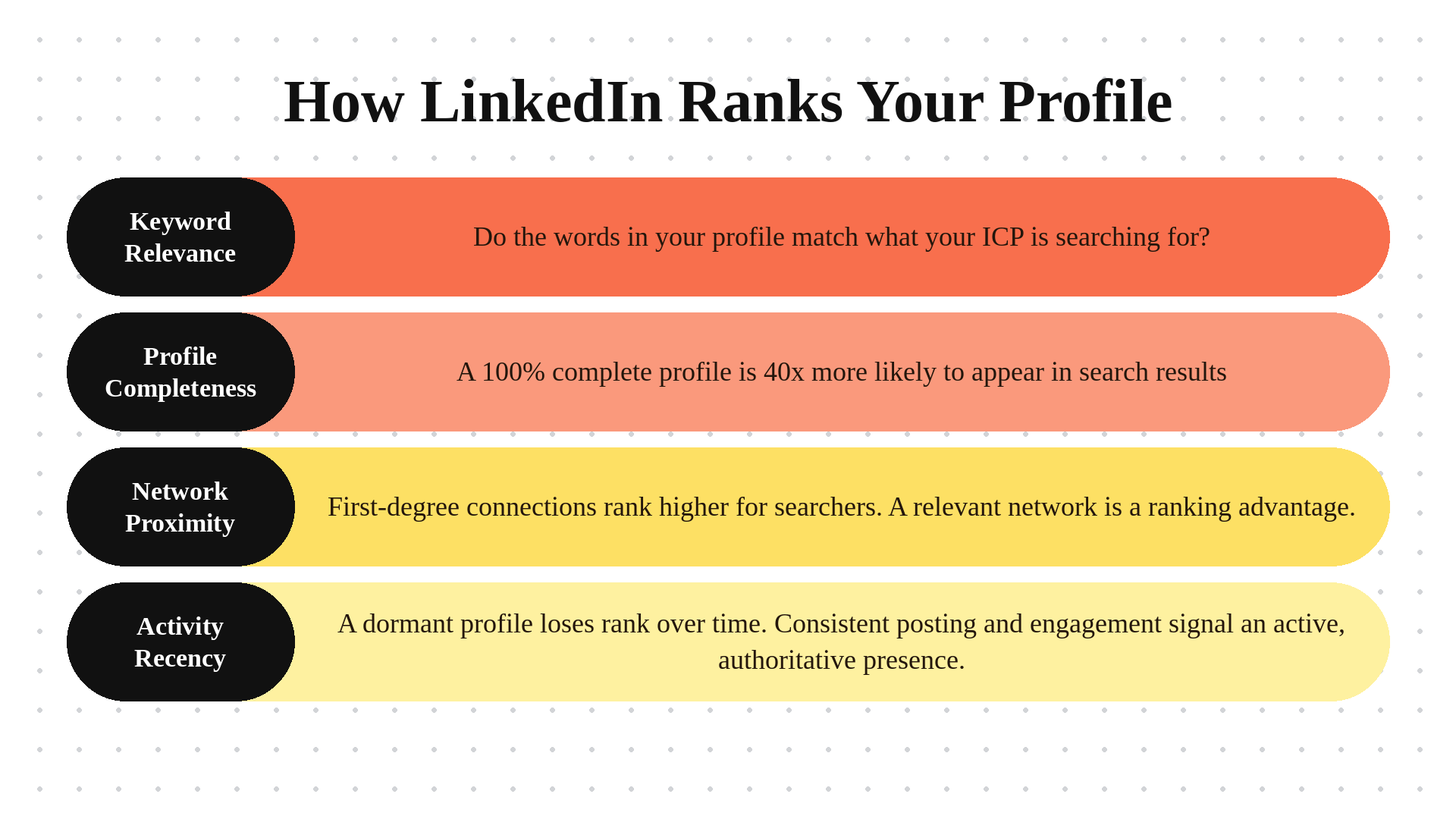
In 2026, LinkedIn's algorithm also understands semantic relevance, meaning it recognizes context and synonyms, not just exact keyword matches. Keyword stuffing actively hurts you. Natural, specific language wins.
How to find the right keywords before you write anything
The goal is to use the language your ICP types into the search bar, not the language your previous employer used internally.
Five methods that work:
- LinkedIn autocomplete: Type a term related to your expertise into the search bar. The dropdown suggestions are real searches from real users. These are your keywords.
- Competitor profile analysis: Find 3-5 profiles of people at your level who are clearly getting inbound. What language do they use in their headlines and About sections that you are not?
- Job description mining: Search for senior roles in your domain. Job descriptions are written in the exact language your peers and buyers think in.
- Your existing inbound language: Look at DMs and emails from people who found you. How did they describe what they were looking for? That is your best keyword data.
- Google Keyword Planner: Enter your role or specialty. Keyword trends on Google often overlap with LinkedIn searches, especially for executive and domain-specific terms.
How many keywords do you need?
Pick 3-5 keyword phrases that precisely describe what you do. Weave them naturally across your headline, About section, and current experience description. Here is what that looks like by role:
| Role | Primary keywords | Supporting keywords |
|---|---|---|
| Startup CEO / Founder | go-to-market strategyB2B SaaSstartup growth | pipelineICPARRfundraisingmarket expansion |
| CTO | engineering leadershiptechnical strategyCTO | cloud architectureplatform scalingengineering team |
| VP / Director of Sales | enterprise salesrevenue growthB2B sales | pipeline managementdeal velocitysales leadership |
| CMO / VP Marketing | demand generationB2B marketingbrand strategy | content strategypipeline generationGTM |
Not sure if your LinkedIn profile is actually getting you in front of the right people?
Get a free LinkedIn profile audit from SuperStrat
How to Write a LinkedIn Headline That Builds Authority and Ranks in Search
Your headline is the single most important field on your LinkedIn profile for two reasons: it is the most heavily weighted section in LinkedIn's search algorithm, and it is the first thing a visitor reads when they arrive at your profile.
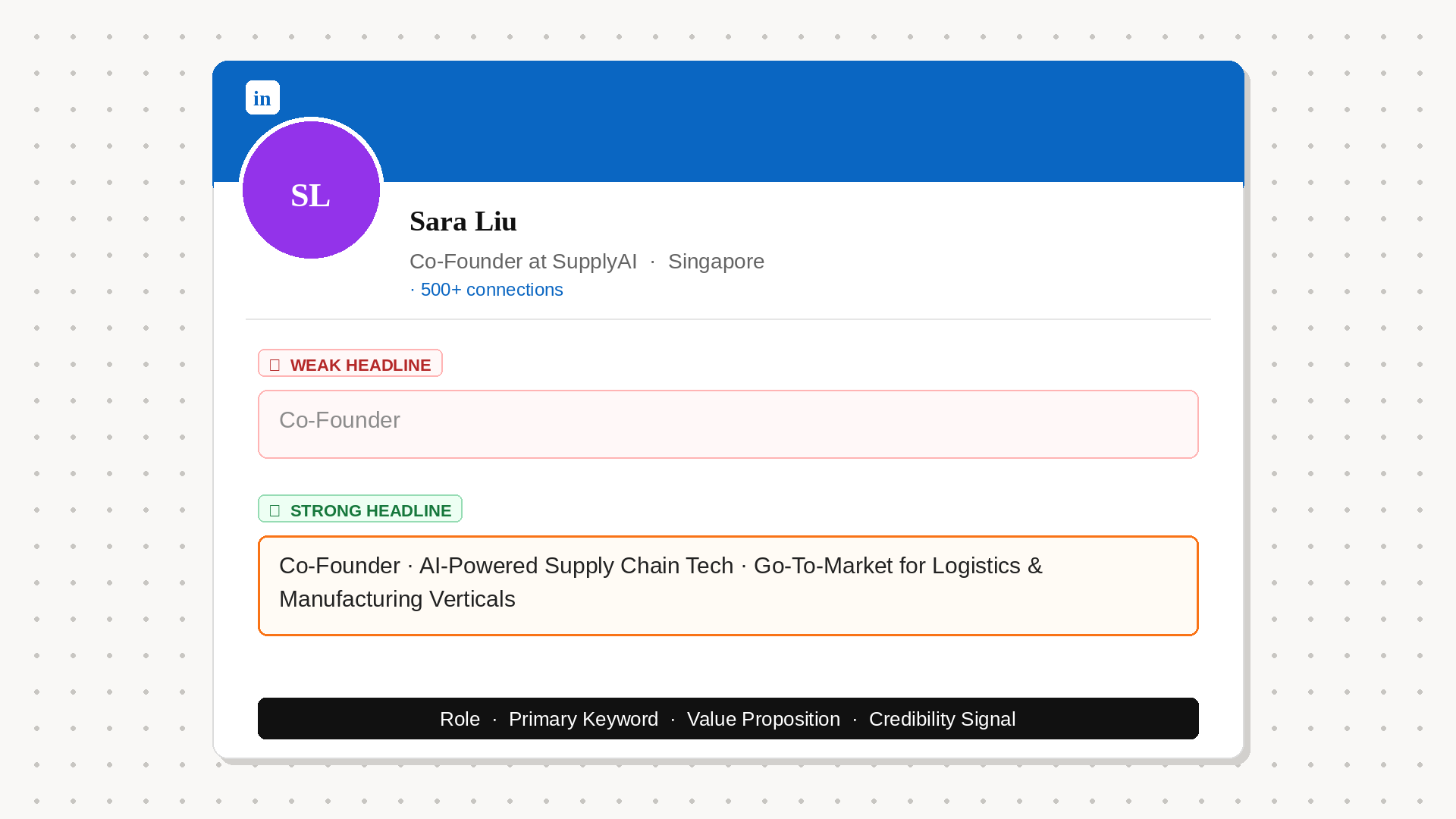
Most founders and executives waste it entirely. "CEO at [Company]." "Co-Founder." "Director of Sales." That tells the algorithm nothing and tells a visitor even less.
The headline formula for executives:
Role + Primary Keyword + Value Proposition + Credibility Signal
CEO
- Before: "CEO at TechCorp"
- After: "CEO at TechCorp · Helping B2B SaaS companies scale from $1M to $10M ARR · Go-To-Market & Product-Led Growth"
CTO
- Before: "CTO, FinTech Startup"
- After: "CTO · Building Scalable Fintech Infrastructure · Cloud Architecture & Engineering Leadership · Series B"
Director of Sales
- Before: "Director of Sales"
- After: "Director of Sales · Enterprise B2B · Helping SaaS companies close 6-figure deals faster · Revenue Growth & Pipeline Strategy"
Co-Founder
- Before: "Co-Founder"
- After: "Co-Founder · AI-Powered Supply Chain Tech · Go-To-Market for Logistics & Manufacturing Verticals"
Each rewritten headline does three things at once:
- Contains keywords your buyers, investors, or partners would actually search for
- States who you help and what outcome you create
- Signals the stage, vertical, or domain you operate in
You have 220 characters. Use all of them. The headline is not a place for minimalism.
What to remove immediately:
- "Passionate about," "results-driven," "strategic visionary," "dynamic leader"
- A job title with nothing else
- Buzzwords that appear on millions of profiles and differentiate nobody
How to Write a LinkedIn About Section That Earns the Scroll
Most people write their About section once, forget it for years, and assume it is doing something. It usually is not.
The typical About section reads like a cover letter nobody requested. Third person, past-focused, and structured like: "John is a seasoned professional with extensive experience in..." Nobody who can move your business forward is reading past line two of that.
LinkedIn moved the About section to the top of your profile in 2025, making it one of the first things a visitor reads. It is also the second most indexed section for search after your headline. The first 300 characters appear in LinkedIn search previews and in Google results when your profile surfaces there. Your opening lines need to carry your most important keyword and your clearest positioning in the same breath.
The three questions your About section must answer:
- Who are you talking to: ICP you are trying to reach, not everyone.
- What do you believe or what problem do you solve: Lead with a conviction, not a credential.
- What do you want this person to do next: Follow you, DM you, click a link. Tell them.
Most executives answer these in reverse order. They spend most of the section on their credentials and give the visitor no reason to care.
Lead with a conviction, not a career summary
The most effective About sections open with a point of view. Not:
"I have 12 years of experience in enterprise sales."
But something like:
"Most enterprise sales teams are not losing deals because of the product. They are losing them because the buying committee never fully understood the problem the product was solving. That is the gap I have spent six years building systems to close."
That kind of opening tells the visitor how you think. If your ICP has lived through that exact frustration, they will read everything that follows.
About section structure that works for founders and executives:
| Part | What to write | Length |
|---|---|---|
| Opening | A conviction or sharp problem statement your ICP recognizes immediately. Contains your primary keyword. | 1–2 sentences |
| Context | What you have done, who you have worked with, framed as evidence of your opening conviction — not a career timeline. | 2–3 short paragraphs |
| Proof | A specific outcome, result, or example. Numbers if you have them. | 1–2 sentences |
| Call to action | A soft next step: DM me, follow along, here is a link. | 1 sentence |
Naturally integrate 5-7 keywords across the About section. Use them in context, not in a list. Keep the total length between 1,200 and 1,800 characters: long enough to build credibility, short enough to hold attention.
One rule that is non-negotiable: write in first person throughout. Third-person About sections read like press kit bios and create distance. A human being is on the other side of this profile. Write like one.
How Your Profile Photo and Banner Build Credibility Before Anyone Reads a Word
Before a visitor reads anything, they have already formed an impression based on what they see. Most founders and executives treat the visual elements as afterthoughts. They are not.
Profile photo:
Profiles with professional photos receive 21x more profile views and 9x more connection requests than profiles without them. The practical standard is that your face should fill roughly 60% of the frame, the photo should be recent, and it should look like you actually show up to important meetings looking like that.
The photo also signals tone. A founder who writes sharp, provocative content should not have a photo that looks like a corporate HR headshot from 2015.
Banner image:
Roughly 67% of LinkedIn users leave their banner blank. That wastes the most visible visual real estate on your profile. Your banner should do one of two things:
- Reinforce your positioning in a single clear statement
- Signal the world you operate in with enough specificity that the right visitor immediately recognizes it as their world
A stock image of a skyline communicates nothing. A banner that names your audience, shows proof of your work, or states your point of view communicates intent before anyone has read your headline.
How to Use the LinkedIn Featured Section as a Proof Layer
The Featured section sits directly below your intro card and renders before your experience. It is the first place a profile visitor clicks when they want to go deeper. It is also one of the most neglected sections on the platform.
While the Featured section does not directly feed LinkedIn's keyword index, it contributes to dwell time, meaning how long someone stays on your profile. Longer dwell time signals to the algorithm that your profile is genuinely valuable, which improves your search ranking.
More importantly, it is where you show rather than tell.
What belongs in your Featured section:
Lead with your strongest piece: most credibility-dense, most ICP-relevant, most recent.
| Role | Best content to pin |
|---|---|
| Founder / CEO | A high-performing post that articulates your market thesis or company milestone. Your newsletter if you have one. |
| CTO | A technical article, architecture decision write-up, or engineering leadership post with strong engagement. |
| Director / VP | A case study or outcome post. "Here is how we grew pipeline by 40% in one quarter" beats any personal bio. |
What does not belong here: your company homepage, a post from three years ago on a topic you no longer focus on, or a generic "learn more about me" link.
Rotate your Featured section every quarter. A stale Featured section signals inactivity, and that is the last signal a thought leadership profile should send.
How to Build Credibility Through Skills, Endorsements, and Recommendations
These three sections are consistently underbuilt by executives. They contribute both to LinkedIn's search algorithm and to the trust judgment a visitor makes when evaluating whether you are who your headline claims you are.
Skills:
LinkedIn's own research shows that users with at least 5 skills listed are 27x more likely to be found in searches. Your skills section is effectively a keyword tag cloud that the algorithm reads alongside your headline and About section.
- List 15-20 skills focused on your actual domain expertise
- Pin your top 3 skills to the highest-visibility slots
- Remove generic skills like "Microsoft Office," "Teamwork," or "Communication" that dilute your signal
- Aim for at least 5 endorsements per key skill from credible people in your industry
Recommendations:
Recommendations are the only section someone else writes. They carry a category of credibility that no amount of careful self-description can replicate.
| Weak recommendation | Strong recommendation |
|---|---|
| "Great to work with, highly professional" | "Redesigned our entire GTM approach for Southeast Asia in six weeks and helped us close our first enterprise deal in the region" |
When requesting a recommendation, be specific about what you want addressed: the strategic decision you helped make, the outcome you produced together, the way you approached a problem that was unusual.
What LinkedIn Creator Mode Does and Whether You Should Turn It On
LinkedIn Creator Mode has been available since 2021. As of early 2026, over 14 million members have activated it. For founders, CEOs, and executives building thought leadership, it is worth understanding before you decide.
What it actually changes:
- Switches your primary button from "Connect" to "Follow," removing friction for people who want to subscribe to your content without being a connection
- Moves your Activity section above your Experience section, making your profile content-first instead of credential-first
- Signals to LinkedIn's algorithm that you are a content publisher, which affects how the platform distributes your posts
- Unlocks LinkedIn newsletters and LinkedIn Live
| Turn it ON if | Keep it OFF if |
|---|---|
| You post at least once a week | You are actively job seeking |
| Your goal is audience building and inbound | You post infrequently or inconsistently |
| Thought leadership is your primary LinkedIn purpose | You rely on direct networking over public audience building |
One caveat: Creator Mode amplifies what you are already creating. A well-configured Creator Mode profile with no consistent content behind it is infrastructure with no traffic.
How to Write a LinkedIn Experience Section That Proves Your Track Record
The Experience section is the most overlooked optimization opportunity on a thought leadership profile. It feeds LinkedIn's keyword index, signals domain depth to the algorithm, and is where serious prospects, investors, and partners go to verify that your headline and About section are backed by real history.
Outcomes over responsibilities:
| Responsibility statement | Outcome statement |
|---|---|
| "Led product strategy and roadmap" | "Built product roadmap for enterprise SaaS platform, scaling from 200 to 2,000 customers in 18 months" |
| "Managed go-to-market activities" | "Designed B2B GTM strategy for US market entry, generating $1.8M in pipeline within the first year" |
| "Oversaw engineering team" | "Led 40-person engineering organization through migration to microservices architecture, reducing infrastructure cost by 35%" |
| "Responsible for business development" | "Closed 6 enterprise partnerships in MENA contributing $2.4M ARR, establishing company's first presence outside India" |
Two to three sentences of specific, outcome-oriented language per role does more to build credibility than three paragraphs of responsibility listings. Use the language your ICP uses, not internal corporate terminology. If your buyers say "pipeline," write pipeline. The vocabulary alignment affects both search visibility and how quickly a prospect recognizes that you understand their world.
Why Your Profile and Content Strategy Are the Same Decision
Most LinkedIn profile guides treat the profile as a one-time project: fix the sections, update the photo, move on. What they leave out is the part that actually produces compounding results over time.
Since LinkedIn's 360Brew algorithm update in 2026, your profile and your content are no longer independent. The platform cross-references the topics you post about against your stated expertise on your profile. Post consistently within your domain and the algorithm supports your reach. Post outside it and the algorithm applies friction.
Your thought leadership profile and your content strategy need to be built from the same positioning decisions.
What engagement looks like for founders and executives who are building authority:
It is not liking posts. It is not leaving "great point!" in comment sections. Engagement that builds thought leadership means showing up in the right conversations with a substantive point of view and demonstrating that you understand your ICP's problem better than they articulated it.
Activity that directly improves your profile's search ranking:
| Activity | Why it matters |
|---|---|
| Posting 2–3x per week | Active posting signals an authoritative, current profile to the algorithm |
| Commenting meaningfully on ICP content | Expands your visibility into their network; improves second-degree proximity ranking |
| Receiving saves and comments on your posts | Dwell time and engagement signals that lift your overall profile authority |
| Growing connections in your domain | Network proximity directly affects how you rank in searches run by people near your ICP |
Your network is your distribution infrastructure. Who is in it determines how far your ideas travel and how well you rank for the searches that matter.
LinkedIn Profile Mistakes That Are Quietly Hurting Your Credibility and Search Ranking
| Mistake | Why it costs you |
|---|---|
| Headline is just a job title | Zero keyword value and zero positioning. You rank for nothing your ICP searches for. |
| About section written in third person with no keywords | Low search index value. No reason for the right person to keep reading. |
| Featured section not updated in years | Signals inactivity. Reduces dwell time. Worst possible signal for thought leadership. |
| Poor or outdated profile photo | LinkedIn data shows a direct impact on connection acceptance rates, InMail responses, and profile conversion. |
| Buzzwords everywhere | "Passionate," "results-driven," "dynamic." These appear on millions of profiles and mean nothing specific. |
| No clear next action | If your profile does not tell the visitor what to do, they leave. Most of them do. |
| Default LinkedIn URL with random numbers | Missed Google discoverability opportunity. Looks incomplete. |
| Skills section too broad or generic | Dilutes keyword signal. Reduces relevance score for searches that matter. |
| Profile set to private | Invisible to Google search. Invisible to searches outside your first-degree network. |
| Profile-to-content mismatch | Under the 2026 algorithm, posting outside your stated expertise domain directly suppresses your reach. |
See yourself in more than three of these? Your profile is actively working against you.Talk to SuperStrat team about fixing it →
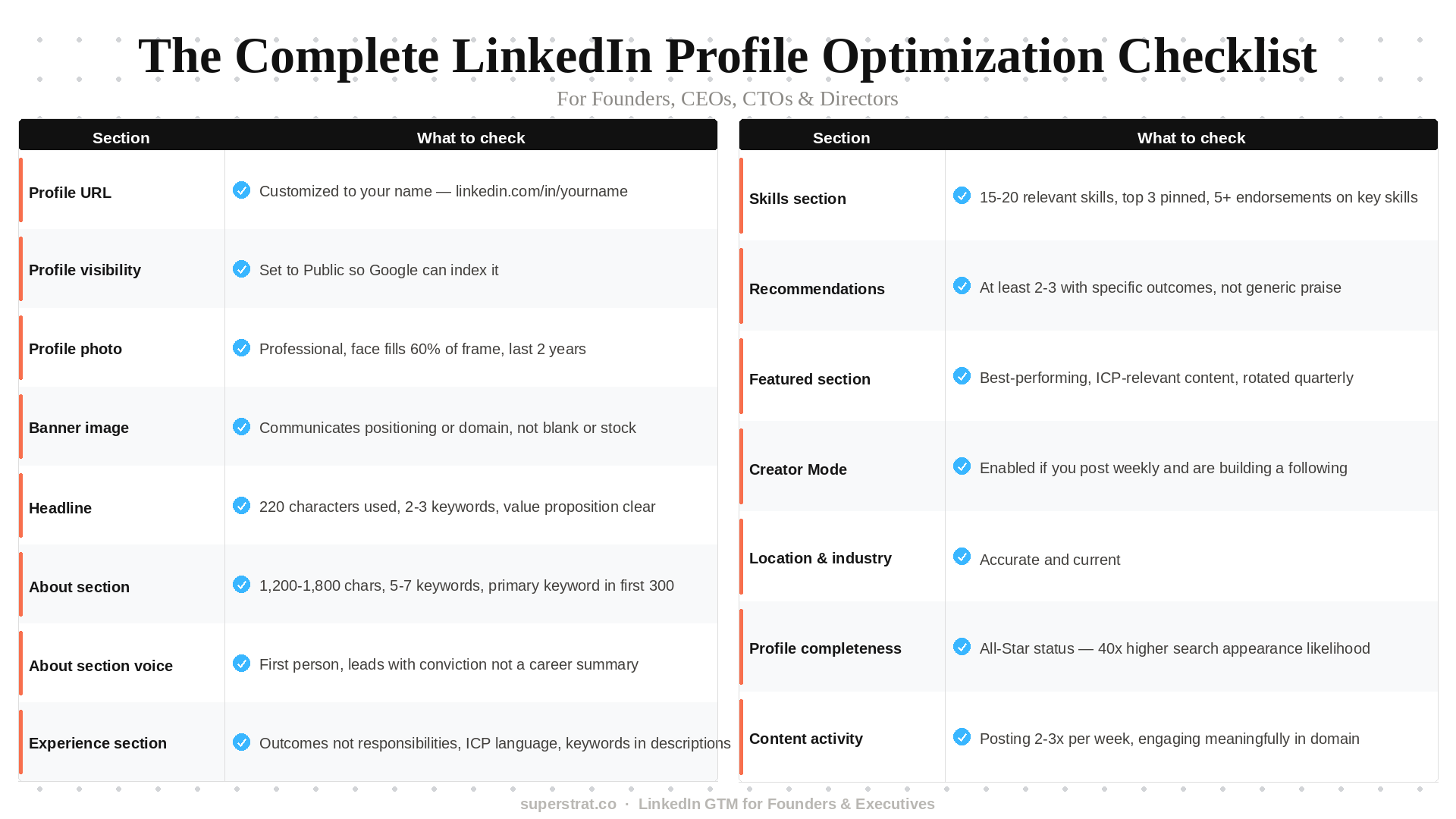
The Complete LinkedIn Profile Optimization Checklist for Founders, CEOs, CTOs, and Directors
Use this before your profile goes live. Every item either affects your search ranking, your credibility with the visitor who arrives, or both.
Why Getting This Right in 2026 Matters More Than It Ever Did
LinkedIn crossed 1 billion members and has become the primary search engine for professional expertise. Buyers research vendors on LinkedIn before they ever visit a website. Investors look up founders before responding to a cold email. Partners search for collaborators the same way they search Google.
In early 2026, LinkedIn's 360Brew algorithm update made the bar significantly higher for generic content and profiles. The platform now rewards people who show up with specificity, depth, and a human voice that cannot be replicated at scale. Generic profiles built around buzzwords are being actively deprioritized.
For founders, CEOs, CTOs, and directors, this is a direct business opportunity. Most executive profiles in this space are significantly under-optimized. The bar for ranking well and building genuine thought leadership authority is not that high, because most people have not done the work this article covers. The executives who build this properly now will compound that advantage for years.
Your Profile Is the Foundation. Everything Else Builds on Top of It.
Here is the complete system in one place:
Getting the profile right is the foundation, not the destination. What compounds on top of it is content that expresses your thinking with genuine specificity, engagement that expands your reach into the right conversations, and a consistency of presence that turns profile visitors into followers and followers into inbound conversations that would not have happened otherwise.
The gap between where most founders and executives sit on LinkedIn today and where their actual expertise positions them to be is a real business problem. People who should be finding you are not. Deals that should start warm are starting cold. Markets you are actively trying to enter do not know you are the right person to talk to yet.
That is the gap SuperStrat closes.
If you are a founder, CEO, CTO, or director who wants to make LinkedIn work as a real go-to-market channel rather than just a presence you maintain out of obligation, let us talk about what your profile is currently signaling and what it should be doing instead.
SuperStrat Labs is a LinkedIn GTM agency. We help founders, executives, and companies turn LinkedIn into a system that builds visibility, credibility, and pipeline through organic content, ecosystem engagement, and go-to-market execution.
Frequently Asked Questions
Review it quarterly. Update it whenever your positioning shifts, you have new proof points, or your ICP changes. Your profile and your content should always be in sync.
LinkedIn works like a search engine. Without the right keywords in your headline, About, and Experience sections, you will not appear in results when buyers search for what you do.
A regular profile is a CV that documents your career. A thought leadership profile is a positioning asset that presents you as the authority your ICP is looking for.
Ready to start?
Turn your LinkedIn into a pipeline engine
SuperStrat works with a small number of B2B founders at a time. See if you’re a fit.
Book a Call →