.svg)


TL;DR
- Most founder content on LinkedIn fails not because of inconsistency, but because there is no real point of view behind it.
- The founders who win are not posting more, they are showing how they think, backing it with proof, and earning trust over time.
- If done right, LinkedIn stops being a content channel and becomes a compounding pipeline engine.
Table of Contents
Look, if you're a founder reading this, I probably don't need to sell you on the idea that LinkedIn matters.
You already know it does. You've seen competitors show up in your feed, build momentum, attract the kind of conversations you wish you were having. You've probably told yourself (more than once) that this is the quarter you finally take it seriously.
And yet, here you are, searching for answers. Which tells me one of two things:
- Either you haven't started, or
- You've started and it's not working.
Let’s fix that.
I’m going to skip the part where I tell you LinkedIn has a billion users and B2B buyers are spending more time on the platform than ever. You know all that. What you need is a playbook that goes beyond "post consistently and engage with your network".
This is the guide to building LinkedIn thought leadership that does more than rack up impressions. We’re going to walk you through what it takes to build real trust with the people who actually matter to your business and eventually, move them closer to a conversation, all of the back of what we’ve learnt running these projects for individuals and businesses over the past 3 years.
Why Most Founder Thought Leadership on LinkedIn Doesn't Land
Here's what usually happens.
A founder decides they need to "be more active on LinkedIn." They write a few posts about their journey, share a company milestone, maybe sprinkle in a motivational insight or two. They post for about three weeks. The engagement is underwhelming. The dopamine hit doesn't come. LinkedIn quietly slides back down the priority list, and the founder goes back to running the business.
Three months later, the cycle repeats.
Effort, consistency - none of these are the heart of the problem here The root cause is something most founders never address: they haven’t really planned to build out and vocalize a differentiated point of view.
The POV Problem
If you thought of "hot takes" when I said POV, there’s your first problem. Building a POV isn’t just being contrarian for the sake of racking up comments from people who'll never buy from you. It's a clear, consistent position on how things should work in your industry, shaped by your experience, your decisions, and the outcomes you've seen up close.
Most founders skip this entirely. They jump straight into posting without ever defining what they actually stand for. When you don't have that foundation, you end up producing content that could have been written by literally anyone in your space.
There's no edge, no specificity, no reason for the person who’s pain point you’ve written about to stop scrolling, chuckle to themselves and think, "Yeah, you and me both buddy."
Before you write a single post, sit with these questions:
- What do I believe about my industry that most people in my space aren't articulating?
- What conventional wisdom have I seen fail, or succeed in ways nobody expected?
- What do my best customers wish the rest of the market understood?
If you can't answer those clearly, you're not ready to post. Time to get thinking.
Figure out the one thing people should know you for on LinkedIn. Nail that positioning, and everything else clicks into place: your tone of voice, your content strategy, what your posts actually look like. Without it, you're just adding more noise to a platform that’s more incoherent AI-powered cacophony than actual insight.
The Trust Architecture: What Actually Builds Credibility on LinkedIn
Trust on LinkedIn isn't built through one viral post, a polished banner image or a clever headline. It's built through repeated, relevant exposure to someone whose thinking feels earned, rather than performed.
Think about the founders you actually trust in your own feed.
You trust them because over weeks and months, they showed up with a perspective that felt real. They demonstrated depth and proved they knew what they were talking about, by actually showing you how they think.
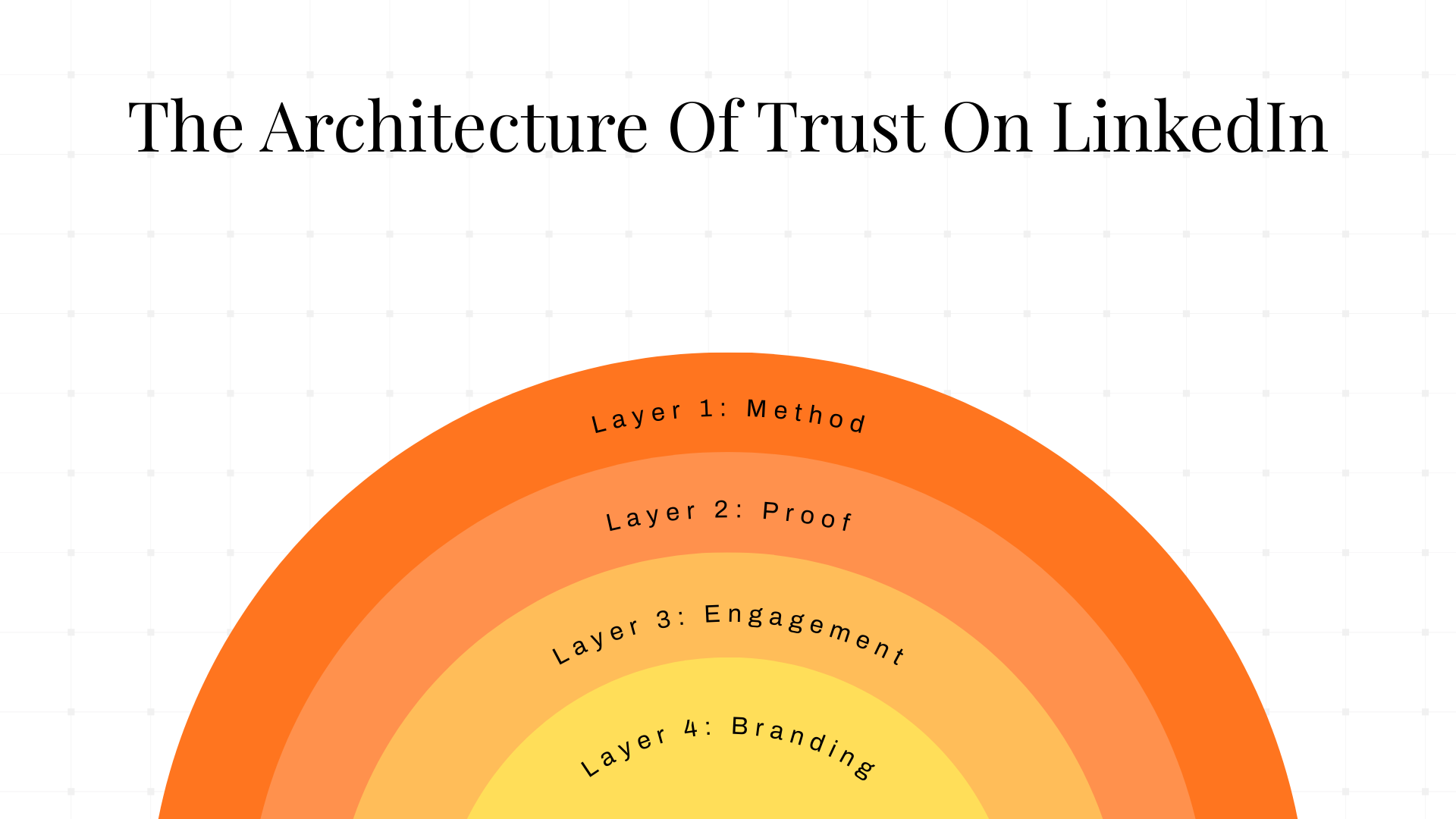
That's the credibility engine you need to build. It runs on four layers.
Layer 1: Method
This is where thought leadership actually lives.
The method shows your audience how you’re solving the problem you’re focused your whole professional life around. It's your outlook on the industry you work in, personal and professional values reflected in your content. Your thought process and frameworks, clearly on display, with absolute transparency.
This is the layer most founders underinvest in, because it requires actual intellectual work. You can't fake the method. It just isn’t something you can outsource to a template.
It comes from years of doing the work, forming opinions, testing ideas, failing at some, and developing a genuine perspective on how things should be done.
When a founder shares their method, not just what they think, but how they think, that's when the audience starts to lean in. That's the content people save, share, and reference in conversations you'll never see. And that's the content that positions you as someone worth listening to, not just someone who posts a lot.
The founders who win on LinkedIn aren't the loudest. They're the most transparent about how they operate.
Layer 2: Proof
Talk is cheap. Especially on LinkedIn, where everyone's a "visionary" and every startup is "disrupting" something.
The third layer of the trust architecture is proof and it's what separates founders people listen to from founders people actually believe.
Proof shows up in several forms:
- Raw, unstructured, unsanitized client conversations Not the carefully curated and crafted testimonials, the easy and the difficult conversations that you have day in and out that show you’re in the trenches.
- Social proof that shows what you’re doing actually works in the real world. The results you’ve driven and the outcomes you’ve delivered, the impact you've had on the people and businesses you work with.
- Commentary and thought pieces that show you zoom out and think big picture. How you're progressing your industry through your own projects.
Post about a framework you use, and then follow it up with a story about how that framework played out in an actual engagement, with specific context and real outcomes, that's proof working.
Share how a client conversation challenged your own assumptions.
Talk about what you're building and why, with enough specificity that people can see the ambition and the substance behind it.
Most founders default to either pure abstraction (big ideas, no evidence) or pure self-promotion (look what we did). The sweet spot is in between: insight backed by experience, shared with enough honesty that people trust it.
Layer 3: Engagement
You don't build trust on LinkedIn by dropping content into the feed and walking away. That’s you treating a social platform like a publishing software. At best, you build awareness. Trust is still a long shot.
The fourth layer is engagement, the one most founders I’ve spoken to have treated as optional.
Conscious engagement means you're actively participating in the ecosystem. When done right, liking, commenting, resharing and reposting become signals to others in your niche that you’re actively driving the conversation. You're showing up in other people's comments with something genuinely substantive to add, not just a CFBR or a Congratulations. You're feeling the pulse of the industry in real time: what people are talking about, what they're struggling with, what's resonating and what's falling flat.
When your ICP sees your name showing up consistently and see that you’re actively and genuinely adding to the conversation, they begin to trust and respect what you have to say. That's when trust compounds. Familiarity built before you ever ask for anything.
And by the time a direct conversation happens, they already feel like they know how you think.
Remember: Engagement isn’t a maintenance chore or a sidequest. It is the ultimate form of intelligence gathering. Every comment section is a window into what your market is thinking. Use it.
Layer 4: Branding
Picture this: Someone’s seen your post, it connects with them. They get curious and want to see who you are and if you could help them solve an issue they’re seeing in their business.
They land on a barren profile - a vague headline that says “Shooting for the moon”, a banner section that’s empty, an about section that gives so little away, it could play poker professionally.
Your LinkedIn profile is your storefront. Most founders treat it like an afterthought.
When someone lands on your profile, they’re interested in something you have to offer. Your content isn’t going to be of use at this point. What matters is how you’ve setup the storefront for context.
Your profile needs to do three things clearly: reflect the organization you represent, communicate the problem you solve, and signal who you solve it for. That's it. But most founders fail at all three.
A headline that says "Founder & CEO at [Company]" tells me nothing. Lead with the problem space you operate in and the perspective you bring to it.
Your About section isn't a bio, it's your literal manifesto to the professional world. Write it like a human being who has a point of view, not like a press release that got run through a corporate filter.
Your experience section should tell the story of what you've built and the outcomes you've driven, not just list titles and tenure.
And your Featured section? That's prime real estate for showcasing the thinking you want to be known for.
Every element of your profile should reinforce the same signal: this person knows what they're talking about, and they're talking about something I care about.
Identifying and Targeting Your ICP on LinkedIn
You've heard the term ICP enough to last a lifetime. But let's talk about what it actually means in the context of LinkedIn thought leadership.
Typically, you might treat ICP as a combination of industry, size, revenue, geography.
That's great for your CRM.
On LinkedIn, however, you need to think at the individual level. Who are the actual humans, by title, by function, by the specific problems they're wrestling with, that you want consuming your content and eventually raising their hand?
Once you have that clarity, everything about your content sharpens. Your language changes to morph into their world. Your examples get more specific and relatable. Your stories land harder because they're speaking to a real person's real situation, not a vague "business audience."
The best part? You can reverse-engineer your ICP by understanding who’s engaging with your content the most. These signals are goldmines.
If the people engaging look like the people you want to reach, you're on the right track. Double down.
If your engagers look nothing like your ICP, your content is too broad. It's attracting attention, but not the right attention.
On LinkedIn, the right impressions from the right people will always beat a bigger number from the wrong ones. Use LinkedIn analytics to track this. Build a habit of reviewing who's engaging, what content they respond to most, and which posts attract your target audience versus a general crowd. That data should feed directly back into your content strategy.
The LinkedIn Content Engine: What to Post and How to Think About It
You don't need to post five times a week or become “a content creator."
You need a system that consistently puts relevant, valuable content in front of the right people. One that you can actually sustain while running through the gauntlet of leading a business.
Content Pillars
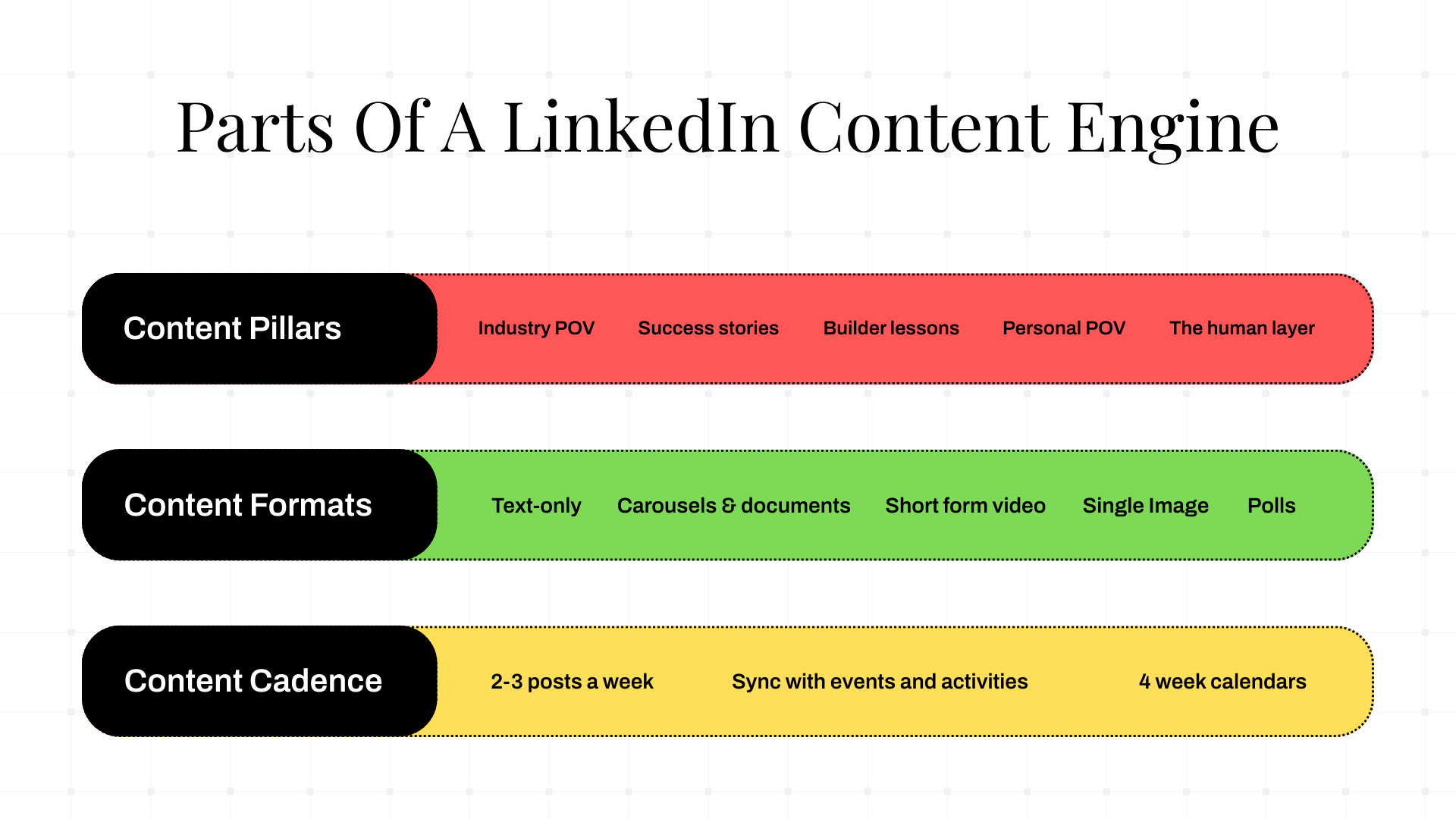
Define three to four content pillars that map back to your POV and your ICP's pain points. These are the recurring themes your content will orbit around. They give you structure without being rigid, and they ensure that over time, your body of work tells a coherent story.
For example, if you're a SaaS founder selling to enterprise buyers (again, this is an example, an actual ICP definition should be much more detailed):
Pillar 1: Market perspective - How enterprise buying decisions are evolving and what it means for the people in that ecosystem. This positions you as someone who sees the bigger picture.
Pillar 2: Builder lessons - The real, hard-won insights from building in your vertical. Not the highlight reel. The actual decisions, trade-offs, and things you'd do differently. This builds credibility.
Pillar 3: ICP-focused content - The operational and strategic challenges your ideal customers face, written in a way that shows you understand their world better than most vendors do. This creates resonance.
Pillar 4: The human layer - Your leadership journey. The behind-the-curtain moments. The personal convictions that drive how you build. This builds connection and makes you someone people want to root for.
Each pillar is distinct and serves a different purpose, but put them all together and they build a complete picture of who you are, how you think, and why someone should pay attention.
Content Formats That Work
Not all formats are equal, and what works shifts over time. In 2026, here's what we're seeing move the needle for founder profiles:
- Text-only posts remain the workhorse. They're fast to produce, easy to consume, and when the writing is sharp, they consistently outperform more elaborate formats. The key is a strong opening line that earns the "see more" click, followed by substance.
- Carousels and documents work well for frameworks, step-by-step thinking, and visual storytelling. They tend to drive saves and shares, which are strong algorithmic signals.
- Short form video content is a bit of a dark horse on LinkedIn. While the platform did try to push this format and give it more weightage to compete with other social profiles, it has since deprioritized this. However, being consistent with this format does reap great rewards.
- Contrarian takes backed by experience spark conversation. But the operative words are "backed by experience." Being contrarian without substance erodes trust faster than it builds it.
But one thing is really clear - you can’t stick to just one content format. What’s really working is to spread your content across all formats.
And here’s a neat little finding from our experience - randomness helps. If you cycle through different content formats in a predictable fashion, your posts start to plateau and then drop in impressions and engagement. Being unpredictable however, helps you maintain the feeling of novelty and keep content fresh in front of users, thereby bringing in more impressions and engagement.
Posting Cadence
Two to three posts per week on a personal profile is the sweet spot for most founders. Consistency matters more than frequency. Showing up twice a week, every week, for six months will produce better results than posting daily for three weeks and then going dark for a quarter.
LinkedIn's algorithm rewards accounts that consistently generate meaningful engagement. If you're regularly putting out content your audience genuinely finds valuable, the platform learns to distribute it to more of the right people over time.
From Visibility to Pipeline: How Thought Leadership Actually Drives Business
Now let's talk about the thing you actually care about.
Here's the honest answer: thought leadership doesn't convert like a paid ad. It doesn't happen overnight, and it rarely follows a straight line. But the mechanics are well-understood, and the results, when they come, are compounding in a way that outbound never is.
The Warm Inbound Effect
When you consistently show up with relevant content and engage with your ICP's ecosystem, something shifts. People start noticing you. They view your profile. They follow you. They engage with your posts. Over time, a subset of these people becomes what we call "highly warmed inbound."
These aren't leads in the traditional sense. They haven't filled out a form or clicked a CTA. But they've consumed your thinking. They've seen you show up again and again with substance. And when the timing aligns (ie, when they have a budget, a mandate, or a pain point that matches what you do), you're already the person they think of first.
Content as Sales Enablement
Thought leadership doesn't just attract new prospects, it’s also a strong influencer in helping you close the ones already in your pipeline.
When a prospect is evaluating you, they will check your LinkedIn. If they see a founder who's been consistently sharing deep, relevant thinking about the exact problems they face, that's a credibility signal no pitch deck can replicate.
Your sales team can and should use your best posts as touchpoints during the deal cycle. A well-timed share of a founder's post that addresses a specific objection or reframes a problem the buyer is wrestling with can move a deal forward more effectively than yet another follow-up email.
Metrics That Actually Matter
If you're investing in thought leadership as a pipeline strategy, measure the right things. Impressions and follower count tell you about reach. They don't tell you about impact.
Track these instead:
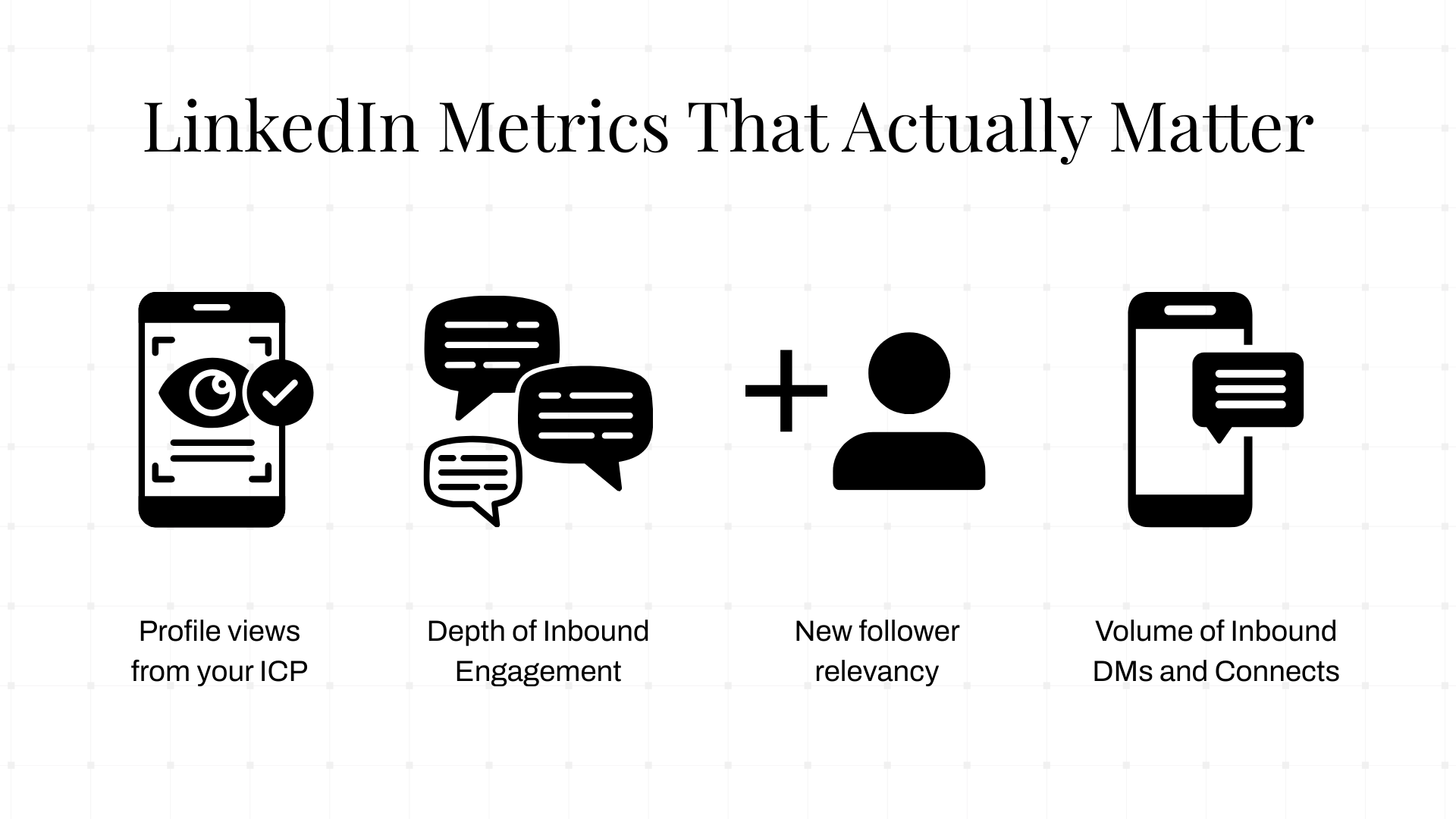
- Profile views from your ICP → Are the right people paying attention?
- Engagement depth → Are people commenting with substance, or just dropping a like?
- Inbound DMs and connection requests from target accounts → Are people coming to you?
- Sales cycle influence → Are deals closing faster because buyers already trust you?
- Pipeline attribution → Ask new opportunities how they found you. “I’ve been following your content on LinkedIn” comes up more often than most founders expect
The Outsource Question: Should You Do This Yourself?
This comes up in virtually every conversation we have with founders, so let's just address it head-on.
You should run your own LinkedIn. Full stop. It's your profile, your thinking, your reputation. If you have the time, the mental bandwidth, and a system that keeps you consistent - do it yourself. Nobody can replicate your authentic voice better than you.
But here's the reality.
When you're building a business, personal brand is usually the first thing to slip. Most founders aren't ignoring LinkedIn because they don't care. They want to be active. They want to build something. They just operate at a level where consistently showing up and maintaining a personal brand keeps taking a back seat to everything else that's on fire.
And inconsistency on LinkedIn isn't neutral - it's actively damaging. A dormant profile with a few scattered posts from months ago undermines credibility more than having no presence at all. It signals that you started something and couldn't follow through. Not the impression a founder wants to give.
If you keep getting in your own way, outsourcing the execution - not the thinking - is a legitimate path. Just make sure it's with someone who takes the time to genuinely understand your voice, your market, and your ICP. Not someone who plugs your name into a content template and calls it thought leadership. That does more harm than good.
The 90-Day Activation Playbook
If you're ready to commit, here's how to structure the first 90 days.
Days 1–14: Foundation
This is the thinking phase. Don't skip it.
Define your POV. Identify your content pillars. Audit and optimize your profile from top to bottom - headline, About section, experience, Featured content. Map out your ICP at the individual level: who are the people you want to reach, and who are the thought leaders, communities, and conversations they already pay attention to?
Build your first month's content calendar. It doesn't need to be complex. A simple document that maps out what you'll post, when, and which pillar each piece connects to. The goal is to remove decision fatigue from the equation so that when it's time to post, you just execute.
Days 15–45: Build the Rhythm
Start posting consistently. Two to three times a week. Begin engaging daily - five to ten thoughtful comments on posts from your ICP, industry leaders, and peers in your space. Not "Great post!" comments. Actual contributions that demonstrate your thinking.
Start sending targeted connection requests to relevant people. Not spray-and-pray. Personalized, intentional requests aligned to your ICP. You're building a network of the right people, not just a large one.
Pay attention to what resonates. Which posts generate real engagement? Which comments spark conversations? Which pieces attract your target audience versus a random crowd? Use that data to refine your approach in real time.
Days 46–90: Compound and Convert
By now, you should have a rhythm. Content is going out consistently. Engagement is building. Your network is growing with relevant connections.
Shift your focus to tracking engagement depth. Who's consistently interacting with your content? Who's viewing your profile repeatedly? Who's showing up in your notifications from the companies and roles you care about? These are your warm prospects.
Don't pitch them. Don't slide into their DMs with a deck. Engage with their content. Build the relationship. Let trust develop at its own pace. By the end of 90 days, you should have a growing pool of highly engaged, ICP-aligned profiles that are primed for a genuine conversation when the timing is right.
What Nobody Tells You About LinkedIn Thought Leadership
Let's close with a few truths that most guides conveniently leave out.
It takes longer than you think. If you expect pipeline in month one, you'll be disappointed. The real returns show up around month four, five, six - and then they start to accelerate. Thought leadership is a compounding asset. The early deposits feel small. The long-term payoff is disproportionate.
Your first posts will probably underperform. That's completely normal. The algorithm is still learning who you are and who should see your content. Your network isn't used to you showing up this way yet. Don't let early metrics shake your conviction in the strategy.
Consistency beats brilliance. One solid post a week, every week, for a year will produce more results than a burst of incredible content followed by months of silence. The founders who win on LinkedIn aren't necessarily the best writers or the deepest thinkers. They're the ones who show up and keep showing up.
Your comments can be as powerful as your posts. Some of the most valuable trust-building happens not on your own content, but in how you show up in other people's conversations. A thoughtful comment in the right place can do more for your visibility than a post that gets modest engagement.
Metrics are lagging indicators. The real impact of thought leadership often shows up in places you can't directly measure - a warmer first call, a shorter sales cycle, a deal that closes because the buyer already trusts you before you've pitched anything.
The algorithm isn't your enemy. LinkedIn's system is getting better at surfacing genuine, niche-relevant content to the right people. If you're creating content that actually helps your target audience think differently about a problem they care about, the platform will eventually catch up. Stop trying to hack it. Start trying to be genuinely useful.
The Bottom Line
LinkedIn thought leadership for founders isn't about becoming a content creator. It's not about chasing virality or optimizing for likes. It's about building a strategic asset - a body of work that positions you as the person your market trusts.
When a buyer in your space has a problem you solve, you want to be the name they think of. Not because you've been pitching them. Not because your SDR cold-emailed them. Because they've been consuming your thinking for months, and they already believe you understand their world better than the alternatives.
That's the kind of trust that influences pipeline. And it starts with a clear point of view, a consistent cadence, the right engagement habits, and the discipline to play the long game.
The founders who get this will build an unfair advantage that no ad budget, no cold outreach sequence, and no sales playbook can replicate.
The question is whether you'll be one of them.
FAQs