.svg)



TL;DR
- LinkedIn thought leadership is more than content. It is strategy, voice, engagement, and reporting tied to business outcomes.
- Look for a structured discovery process, real voice calibration, daily engagement in scope, and reporting beyond impressions.
- A strong agency will understand your business, ICP, sales cycle, and goals before writing anything.
- Expect foundation in Month 1, early signals by Months 2 to 3, and traction by Months 4 to 6.
- If you can run LinkedIn consistently yourself, do it. If not, structured support becomes the lever.
- The longer LinkedIn stays inactive, the wider the gap grows in pipeline, trust, and visibility.
Table of Contents
LinkedIn thought leadership services are easy to describe at a surface level. Content, engagement, profile optimization. Most providers can walk you through a deliverables list. What is harder to evaluate from the outside is the depth behind those deliverables. How the strategy is built. How voice is developed. How engagement is structured. How progress is measured.
If you are evaluating LinkedIn thought leadership services, whether for the first time or after a previous experience, this piece is designed to give you a clear picture of three things:
- What the work actually involves when it is running well
- What to look for and what to ask before signing with anyone
- What results to expect, and on what timeline
This is not a vendor comparison or a listicle. It is a behind-the-scenes look at the process, the involvement, and the depth that go into structured LinkedIn thought leadership.
What LinkedIn Thought Leadership Work Actually Involves

LinkedIn thought leadership involves significantly more than content production. The strategy, engagement, and distribution layers are where the work deepens, and where business impact tends to come from.
Here is what a well-structured engagement looks like from the inside.
It Starts With Understanding the Business
LinkedIn strategy is shaped by business goals, not content ideas. Before anything is written, the work begins with understanding the fundamentals.
Who the client is trying to reach. Specific roles, industries, company stages, and geographies. Where LinkedIn fits within the broader go-to-market motion. What the competitive landscape looks like, who is already visible, and what conversations are happening. What outcomes LinkedIn is expected to contribute to.
What this looks like in practice: A structured discovery process in Week 1, typically a 60-minute workshop. This feeds into narrative definition, content pillar mapping, visual identity development, and full profile optimization covering headline, About section, featured content, and LinkedIn search visibility through keyword alignment. Content production begins only after this strategic foundation is set, usually in Week 2, with a pre-approved monthly calendar tied to business priorities.
Voice Is Built Over Time, Not in a Single Session
The way someone communicates, their cadence, their humor, the way they frame problems, is what makes their LinkedIn presence feel distinctly theirs. Developing that voice is one of the most important parts of thought leadership work, and it takes more than one conversation.
What this looks like in practice: Founder POV themes and brand narrative are defined in Week 1. But voice calibration continues through the first full month of content. The process involves studying how the client actually speaks, in meetings, on calls, in Slack, in unscripted settings. Drafts go through multiple rounds of feedback and refinement. The goal is for every post to feel like it could only have come from the person whose name is on it.
Engagement Is Part of the Daily Work
Content creates visibility. Engagement shapes who that visibility reaches and whether it leads to meaningful conversations.
On LinkedIn, engagement includes thoughtful commenting on ICP posts to build familiarity over time, targeted connection requests aligned to business goals, cross-engagement between founder and company profiles, and tracking which accounts are consistently engaging so that those signals can be built on.
What this looks like in practice: Engagement is part of the daily workflow. This typically includes consistent commenting, targeted connection building with up to 100 requests per week aligned to ICP, follower invites to the company page at 100 to 250 per month, and active monitoring of high-engagement accounts. The engagement layer turns visibility into familiarity, and familiarity into conversations.
Reporting Focuses on Business Outcomes
The value of LinkedIn thought leadership becomes clearer when the metrics reflect business relevance, not just platform activity.
What to track: Profile discovery through search (keyword-driven visibility on LinkedIn). Profile views from ICP roles and companies. Inbound DMs and connection requests from relevant audiences. Engagement depth, where comments carry more weight than likes. ICP-aligned follower growth. Content-assisted pipeline signals, meaning deals where LinkedIn appeared in the buyer's journey. Sales cycle velocity, meaning whether deals are progressing differently since LinkedIn became active.
What this looks like in practice: Monthly performance reports that cover reach but also engagement quality, follower relevance, profile view trends, and inbound signals. Monthly review calls are structured as strategy conversations focused on direction and adjustments, not just a data walkthrough.
The Client's Time Commitment Is Minimal and Focused
A well-structured engagement reduces operational load while keeping strategic input high. The goal is to extract the right context efficiently, not to create additional work for the client.
What this looks like in practice: A single 60-minute monthly conversation to capture context, milestones, and strategic direction. Everything else is handled end-to-end by the team.
A typical monthly scope includes 12 posts on the company page at 3 per week, focused on industry insights and trust-building narratives. 8 posts on the founder's profile at 2 per week, covering POV and market perspective. End-to-end content creation including writing, editing, and design. A pre-approved monthly content calendar tied to business priorities.
What to Look For Before Signing With Anyone
When you are evaluating LinkedIn thought leadership services, the deliverables list will often look similar across providers. What is more useful is understanding the signals that indicate depth, structure, and long-term thinking behind the work.
Here is what is worth paying attention to:
- A structured discovery process before content begins: The engagement should start with a clear understanding of your business, your ICP, your competitive landscape, and your goals. Content that starts before this groundwork is in place is built on assumptions rather than strategy.
- A defined approach to voice development : Voice takes time to develop. Look for a process that involves studying how you naturally communicate, with calibration built into the first month of content rather than completed at onboarding.
- Engagement included in the core scope: If engagement, including commenting, connection building, and signal tracking, is not part of the standard scope, the service is focused on content production. That is a valid model, but it is a different one from full thought leadership work.
- Reporting connected to business outcomes: Monthly reporting should go beyond impressions and follower counts. Look for metrics tied to audience relevance, engagement quality, and early pipeline signals.
- Clarity on fit and expectations from the start: A strong engagement begins with an honest conversation about whether this is the right approach for where your business is right now, including what realistic timeline and success look like.
- Low operational burden on your side: The engagement should be designed so your time commitment is minimal and focused. If you are expected to spend several hours each week reviewing, editing, and managing the process, the work is being shared rather than managed.
These are signals that the engagement is built around long-term impact, not short-term output.
If you are evaluating LinkedIn thought leadership services and want to understand how our process maps to what we have outlined above, we are happy to walk you through it. We will review your current LinkedIn presence, explain how we would approach your specific situation, and give you a clear picture of scope, involvement, and expected outcomes. No pitch deck. Just a direct conversation.
[Book a Strategy Walkthrough with SuperStrat →]
What a Strong Agency Will Want to Understand Before Starting
Before any content is created, a structured engagement begins with a clear understanding of the business. These are the kinds of questions that shape the entire strategy, and they should be explored before any work begins.
1. What role should LinkedIn play in your business?
- Whether the goal is awareness, pipeline, hiring, investor credibility, market entry, or some combination, the answer shapes everything from content direction to engagement approach.
2. Who exactly are you trying to reach?
- Specific roles, industries, company stages, and geographies. The more precise this is, the more focused the strategy becomes.
3. What does your sales cycle look like, and where does LinkedIn fit within it?
- A two-week sales cycle and a six-month enterprise cycle require very different content and engagement approaches. Knowing where LinkedIn sits in that journey shapes how the strategy is built.
4. Who else is visible in your space?
- What conversations are already happening, and where is there room to contribute something distinct.
5. What has your LinkedIn presence looked like so far?
- What has been tried, what has worked, and what has not gained traction.
6. How do you naturally explain what you do?
- In a meeting or a conversation, not on a website. This is where voice development begins.
7. What does success look like in 6 months?
- These answers shape everything that follows, including the positioning, the content direction, the engagement approach, and how progress is measured.
Ghostwriter, Branding Agency, or GTM Agency: Which Model Fits
LinkedIn thought leadership services come in different forms, and each is designed for a different situation. Understanding the distinction helps match the right approach to the right need.

- Freelance LinkedIn Ghostwriter: Focus is on content production, writing posts in the client's voice. This works well when the client already has clarity on positioning and ICP and needs consistent execution support.
- Personal Branding Agency: Focus is on narrative development, visual identity, and positioning. This works well when messaging, profile, and content direction need to be defined or refined.
- LinkedIn GTM or Thought Leadership Agency: Focus is on content, engagement, distribution, and strategy, all tied to business outcomes. This works well when LinkedIn is expected to contribute to pipeline, market entry, investor credibility, or ecosystem influence, and when the engagement layer is as important as the content.
Comparison Table:
The right choice depends on the problem being solved and the level of strategic involvement needed.
Not sure which model fits your situation? We can help you figure that out. In a 15-minute call, we will assess where your LinkedIn presence stands today, identify what is missing, and recommend the right approach for your goals, whether that is working with us or not.
[Book a 15-Minute Assessment Call →]
What Results to Expect and When
LinkedIn thought leadership compounds over time. The signals change before the outcomes do. Here is what the typical progression looks like.
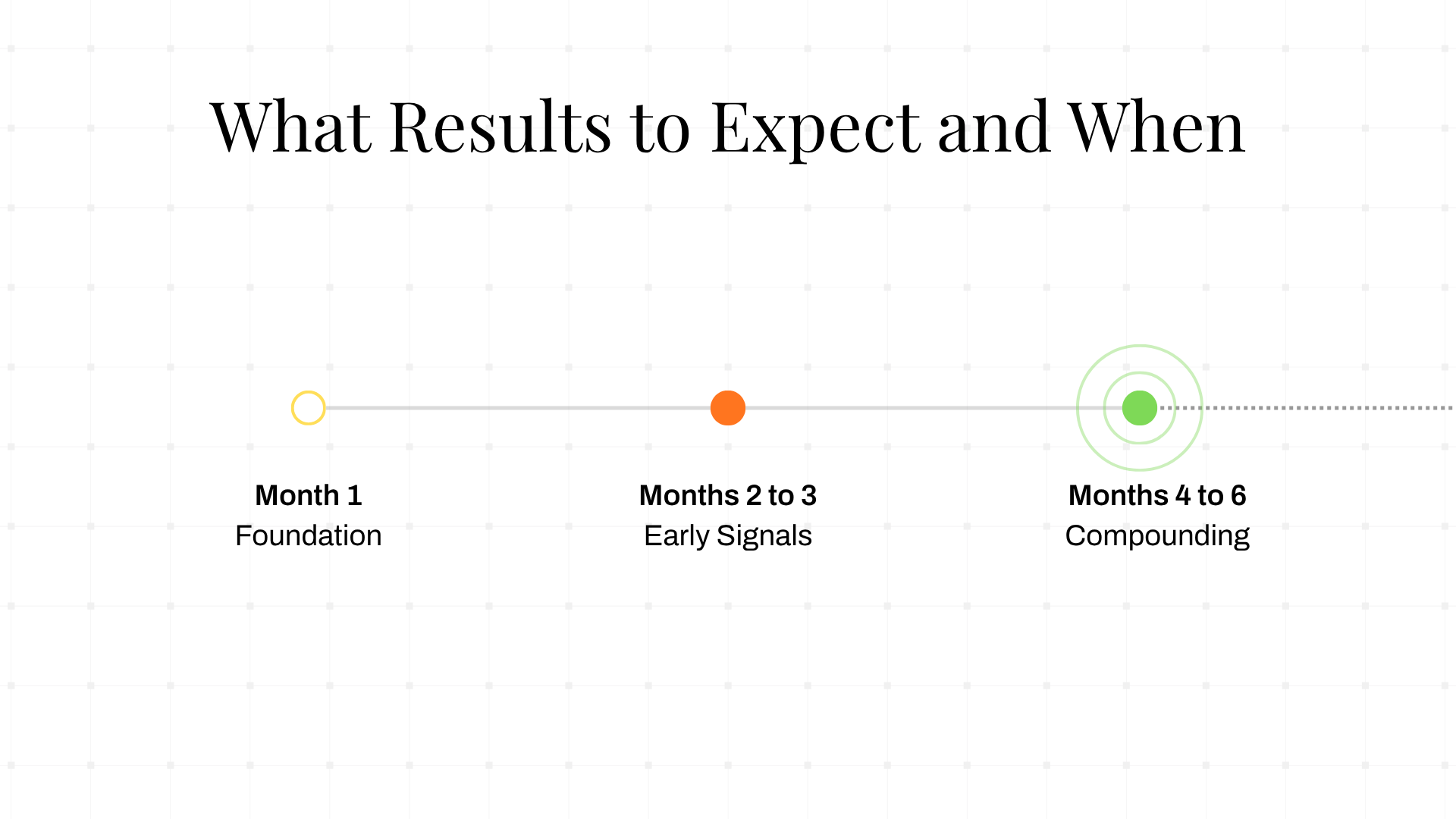
Month 1: Foundation
Profile optimization is complete, covering headline, About section, featured content, visual identity, and LinkedIn search visibility through keyword alignment. Narrative and content pillars are defined. The content calendar is live and first posts are published. Baseline metrics are established.
What to expect at this stage is clarity and consistency. This is the building phase, the foundation that everything else compounds on.
Months 2 to 3: Early Signals
Posting cadence is established and the algorithm begins recognizing consistent activity. Engagement builds with meaningful comments from relevant audiences. The network grows with ICP-aligned connections. Fifteen to twenty-five highly engaged ICP profiles are identified and tracked.
What you might see at this stage includes first inbound DMs, profile views from decision-makers at relevant companies, and people referencing content in conversations.
What we have seen at SuperStrat: A SaaS founder reached an average of 50,419 monthly impressions and added 580+ followers in 3.5 months through consistent, ICP-focused content and engagement.
Months 4 to 6: Compounding
Impressions and network grow with increasing relevance. Inbound conversations become more frequent. Content-assisted pipeline signals emerge, with prospects engaging before booking calls and referencing posts in sales conversations.
What we have seen at SuperStrat: A senior finance leader went from near-zero visibility to 273,165 total impressions over eight months, with monthly follower growth increasing from 87 to approximately 320 per month.
Metrics That Reflect Business Relevance
Track profile views from ICP roles and companies, inbound DMs and connection requests from target audiences, engagement depth where comments carry more weight than likes, content-assisted pipeline where LinkedIn appeared in the buyer journey, and sales cycle velocity where deals are moving differently.
For context, total impressions are more meaningful when filtered by audience relevance. Follower count is more meaningful when assessed by quality. Individual high-performing posts are useful for learning but not for measuring strategy.
When In-House Makes Sense
Not every situation calls for external support. Here is how to think about the decision.
- In-house works well when you have a clear ICP and know exactly who you are speaking to, you can commit 5 to 8 hours per week to content, engagement, and strategy, you have a system rather than just intent that keeps you consistent, and you enjoy the process enough to sustain it over months.
- External support makes sense when consistency has been the challenge and you start and stop, your time is better spent on the business itself, competitors are visible and the gap is becoming noticeable, or speed matters because of a fundraise, market entry, or product launch.
- The middle ground is also worth considering. Some founders start with lighter support to build the habit and then layer in strategy. Others work with a partner for a defined period to build the foundation and then transition to ongoing maintenance.
The decision is less about capability and more about consistency and focus.
Why an Inactive LinkedIn Presence Has a Cost
An inactive LinkedIn presence is not neutral. It has a cost.
Not in theory, but in missed deals, overlooked opportunities, and reduced visibility with the people who matter.
In B2B markets where buyers, candidates, and partners research before they engage, an inactive profile creates silent friction. Conversations that could have started never do, and trust that could have been built earlier is delayed or lost entirely.
The Real Cost of Inactivity on LinkedIn
- Lost Revenue and Missed Opportunities: When your presence is inactive, you are less likely to be discovered, trusted, or considered. Buyers often check profiles before replying or shortlisting vendors. If there is no recent activity or clear point of view, the default assumption is disengagement or lack of relevance.
- Reduced Visibility and Discoverability: LinkedIn is a search-driven platform. Profiles and content are indexed based on keywords, activity, and engagement signals. An inactive profile appears less frequently in search results, reducing visibility to recruiters, buyers, and collaborators actively looking for solutions.
- Erosion of Credibility and Trust: Your LinkedIn presence is often part of your first impression. A dormant profile raises questions, while an active one answers them before they are asked. This directly affects response rates, conversion, and how seriously you are considered.
- Declining Network Value: Without consistent visibility and engagement, you fade from your audience’s active awareness. Fewer interactions lead to fewer referrals, lower engagement, and reduced amplification over time.
- Missed Hiring and Partnership Opportunities: Candidates, partners, and collaborators evaluate leadership on LinkedIn. An inactive presence limits inbound interest and reduces perceived momentum, making it harder to attract high-quality opportunities.
- Stagnant Professional Brand: While others in your space build visibility and narrative, inactivity keeps your positioning static. The gap does not appear overnight, but it widens every month.
The compounding effect still applies. Consistent presence builds recognition over time. Inactivity does not erase past work, but it prevents future momentum. The gap between active and inactive players grows quietly, then becomes visible all at once.
Now you know what the work looks like when it is structured properly. If you are wondering where your LinkedIn presence stands or what it would take to get it where it should be, let us talk. We will review your profiles, map your ICP, and tell you exactly what we would do differently. No slide deck required.
[Let's Talk →]
Frequently Asked Questions:
1. What does a LinkedIn thought leadership agency actually do?
→ A LinkedIn thought leadership agency handles the full system, including strategy, narrative development, content creation, daily engagement, connection building, and performance reporting, all tied to business goals. The client's involvement is typically one hour per month.
2. How long does it take to see results from LinkedIn content?
→ Typically 2 to 4 months before meaningful signals appear. Month 1 focuses on foundation, including profile optimization, narrative, and content pillars. Months 2 to 3 show early traction with engagement from ICP and first inbound conversations. Months 4 to 6 are where compounding becomes visible.
3. Do I need to be involved regularly?
→ Approximately 1 to 2 hours per month. This usually involves a monthly conversation to capture context and direction, plus occasional content review. Everything else, including research, writing, engagement, and reporting, is handled by the team.
4. How is this different from hiring a ghostwriter?
→ A ghostwriter focuses on content production, writing posts in your voice. A LinkedIn thought leadership agency includes that, plus strategy, ICP targeting, daily engagement, connection building, and performance tracking tied to business outcomes. The distinction is between content execution and a full system.
5. What should I measure to understand if LinkedIn thought leadership is working?
→ Profile views from ICP roles, inbound DMs from relevant audiences, engagement depth where comments matter more than likes, content-assisted pipeline signals, and whether sales conversations feel warmer or progress faster. Impressions and follower count provide context but are not sufficient on their own.