
Contents
TL;DR
- Stop measuring LinkedIn by impressions and follower counts. The metrics that tell you whether your positioning is working are ICP-aligned profile views, inbound DMs from target accounts, and whether prospects arrive at first conversations already knowing who you are.
- At any given time, 95% of your target market is not buying. Thought leadership is the only mechanism that builds trust with them before they enter a cycle. Every other LinkedIn activity is fighting over the 5%.
- 'Failure' is almost never due to content quality or frequency. It is wrong ICP, no point of view, and treating LinkedIn as a content platform rather than a positioning channel.
- A positioning system has four components: a profile built as a landing page, a distinct point of view, content that shows how you think, and engagement as a proactive outreach strategy.
- Meaningful pipeline impact takes 6 to 12 months. Founders who understand this build an asset. Founders who expect campaign-style returns at 60 days abandon it and conclude LinkedIn does not work.
You have been on LinkedIn. You posted for a few weeks, maybe a few months. You got some likes, a few comments from people you already knew, and exactly zero inbound conversations from anyone who looked like a real prospect. So you quietly deprioritised it.
The diagnosis you walked away with was probably one of these:
- The content was not good enough,
- You were not consistent enough, or
- LinkedIn just does not work for your market.
None of those are the actual problem.
The problem is that you were running a content activity where a positioning system was required. Those are not the same thing. They produce different results, and the gap between them is not incremental.
This is not a guide to LinkedIn thought leadership in the usual sense. It is not a tips list. It is a framework for understanding what a positioning system looks like, why it produces outcomes that content activity cannot, and what the four components of one actually are.
Most LinkedIn Activity Is Aimed at the Wrong Window
Here is the structural problem with how most B2B founders approach LinkedIn.
At any given time, roughly 5% of your target market is actively in a buying cycle. They have a problem, a budget, and a timeline. They are researching vendors, talking to peers, and responding to outreach.
Every conventional LinkedIn activity, ads, SDR sequences, intent-based content, is aimed at that 5%.
The other 95% are not ready to buy. They may have the problem. They may even know they have it. But the timing is not there. They are invisible to traditional demand capture, and demand capture is invisible to them.

This is the window most founders are missing entirely.
Why Thought Leadership Reaches The 95%
Thought leadership is the only mechanism that reaches out-of-market buyers before they enter a cycle. It builds familiarity, trust, and authority while they are still in the phase where they are not looking at vendors at all.
The 2024 Edelman-LinkedIn B2B Thought Leadership Impact Report found:
The Mechanism Matters
Thought leadership does not accelerate existing demand. It creates the conditions under which demand, when it forms, already has a preferred destination.
The founders who describe pipeline coming from people who "have been following your content for months" are not describing luck. They are describing what happens when the 95% window is actually built into the strategy.
For early-stage founders who worry that a lack of brand recognition puts them at a disadvantage: the 2025 Edelman-LinkedIn B2B Thought Leadership Impact Report found that 53% of decision-makers say when thought leadership is strong, brand recognition matters less. The content is the credential.
Why LinkedIn Thought Leadership Fails for Most B2B Founders
Read this as a diagnostic, not a list of mistakes. Most founders who try LinkedIn and see nothing are not failing because of effort or content quality. They are failing because of structure.
Four patterns account for almost every case.
- The audience is too broad. Content aimed at everyone is relevant to no one in particular. Relevance is what earns attention on LinkedIn. Not polish, not production value, not frequency. When a post could plausibly be for any professional with a business interest, it does not register with any specific person. The ICP has to be specific enough that the right reader feels like you wrote it for them.
- There is no point of view. Content that could have been written by anyone in the space produces the outcome you would expect: nothing. A perspective that is distinct and consistent is what builds recognition over time. Without it, you are not building an audience. You are generating output.
- The wrong channel is getting the investment. Company pages are not the LinkedIn channel that builds the trust and inbound this piece is about. The platform structurally favours personal profiles. Personal profiles consistently outperform company pages by a significant margin. This is not a preference; it is how the platform is built. Founders who invest in company page content while neglecting their personal profile are running the wrong play.
- The metrics are wrong. Impressions, follower counts, and post engagement rates tell you almost nothing about whether your positioning is working. The 2024 Edelman-LinkedIn Report found that 73% of B2B decision-makers say thought leadership is more trustworthy than marketing materials. That trust does not flow to generic content. It also found that only 26% of marketers can measure the link between thought leadership and positive business outcomes, which means most are either optimising for vanity metrics or not measuring at all.
The right signals to track:
- ICP-aligned profile views
- Inbound DMs from target accounts
- Pipeline influence; whether conversations are starting because someone already knows your work
- Whether prospects arrive at first meetings already familiar with your thinking
If those are moving, the system is working, regardless of what the impressions column says.
SuperStrat Labs's positioning audit takes 20 minutes and shows you exactly what is breaking in your current LinkedIn presence and what to fix first. Book yours here.
LinkedIn Personal Profile vs Company Page: Which One Builds Pipeline
For B2B thought leadership, the answer is the personal profile. Every time.
Personal profiles consistently outperform company pages on LinkedIn because the platform is structurally built around people, not organisations. The algorithm favours content from individuals. Engagement rates are higher. Reach is wider. Trust is easier to build when there is a person behind the perspective, not a logo.
Company pages have a role. There are legitimate reasons to maintain one; think brand awareness, recruiting, or product announcements.
But pipeline? Inbound conversations from your ICP? Authority in your market? That work happens on the founder's profile, not the company page.
The mistake most B2B founders make is treating the company page as the primary LinkedIn channel and the personal profile as secondary. They post company updates and expect market presence to follow. It does not.
Market presence is built through people, through consistent founder-led visibility, through a point of view that a human being is willing to stand behind.
Founder-led thought leadership on LinkedIn works because buyers trust people before they trust brands. A founder who shows how they think about a problem their ICP has is doing more pipeline work in one post than a month of company page content.
The personal profile is not a supplement to the company page. For thought leadership and pipeline, it is the channel.
What a LinkedIn Thought Leadership Strategy Looks Like
A system has components that work together. Change one and the others are affected. This is what distinguishes it from a content calendar or a posting schedule. Those are activities. A positioning system is architecture.
The LinkedIn Positioning System has four components. Each one is connected. Change one and the others are affected.
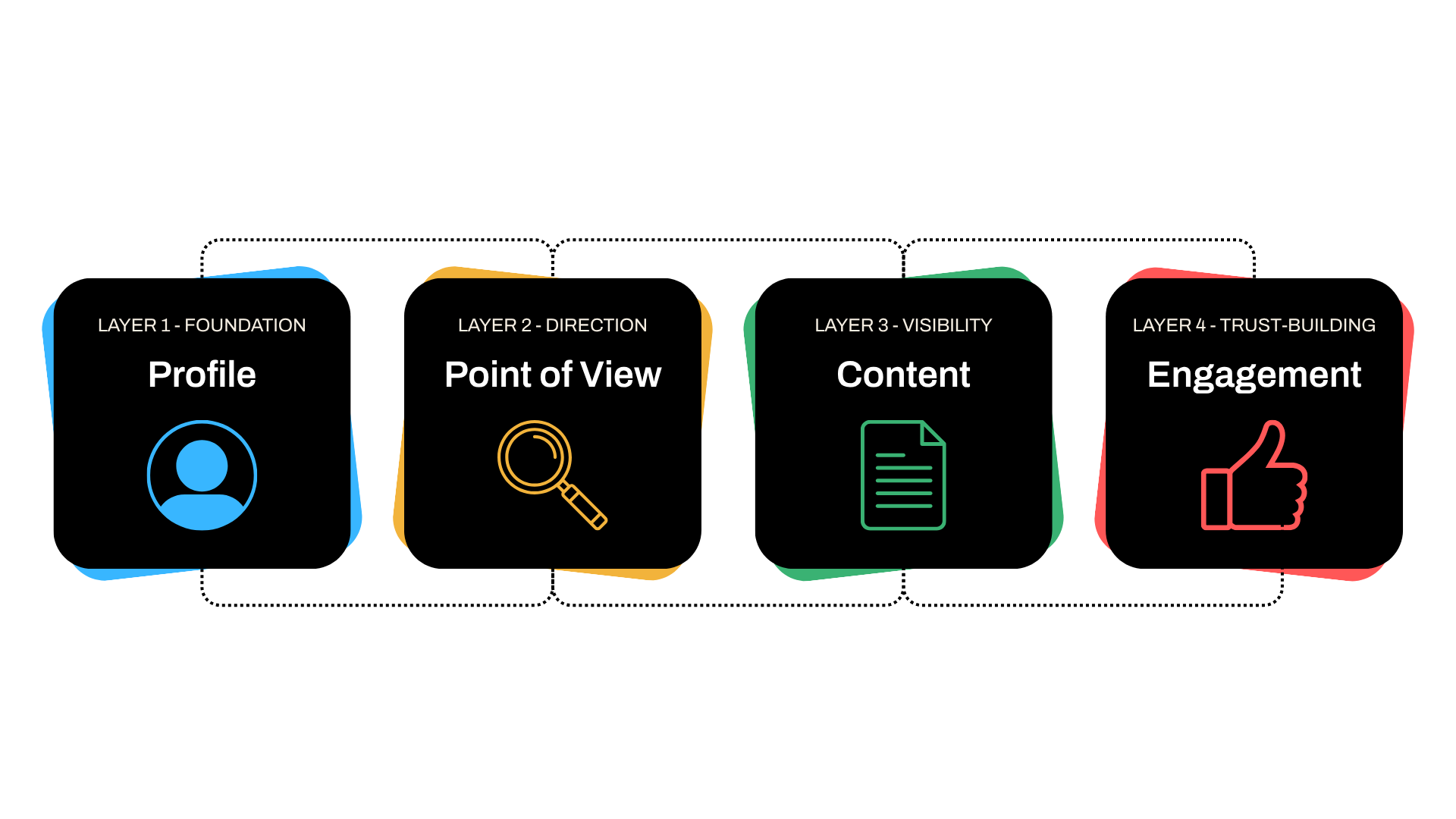
LinkedIn Positioning System Component 1: Profile
Most founder profiles are a professional history. That is not what the profile is for. Its job is to answer one question for the right visitor: is this the person who understands my problem?
- The headline has 220 characters. Use all of them.
- Don't just list your job title and company name, but position yourself in terms of what you do for your ICP.
- The About section is not a bio. It is the first 300 words of the conversation you want to have with your ideal client.
- The Featured section is not a showcase of achievements. It is the next step you want the right visitor to take.
Every word in the profile is a positioning decision. Who you are writing for, and what you want them to believe, should drive all of it.
LinkedIn Positioning System Component 2: Point of View
Not hot takes. Not controversy for its own sake. A consistent, repeatable perspective your target audience can identify as yours over time.
The right point of view does two things simultaneously. It attracts the right people and lets the wrong ones scroll past. And both outcomes are correct.
A POV that resonates with everyone is ambient noise. Period.
Most founders skip this entirely. The result is content that is technically fine and strategically useless. A strong POV is the difference between building an audience and generating posts.
LinkedIn Positioning System Component 3: Content
The failure mode is tips content. Posts that prove you have information but not depth. Posts that could have been written by anyone with a search bar and a content calendar.
The content that actually builds positioning makes the ICP feel understood, not just informed. It shows a reasoning chain. It includes observations from inside your world that an outsider cannot replicate.
The formats that carry this include:
- Analysis of a real problem your ICP has right now,
- A contrarian position held with clear rationale,
- Patterns you have noticed across your work that are not obvious to people outside it.
Two to three posts per week is the right cadence. Consistency matters more than frequency beyond that threshold.
LinkedIn Positioning System Component 4: Engagement
Engagement is not responding to comments on your own posts. It is showing up in conversations your ICP is already having, before they have ever heard of you.
That means commenting in their threads, engaging in industry discussions, adding a perspective where your ICP can see it and evaluate it. By the time they see a post or a connection request from you directly, you are already familiar. Familiarity is trust at an earlier stage.
This is how authority compounds without a paid campaign. The investment is attention and time.
The return is that when a buyer eventually enters a cycle, they do not need to be convinced of your credibility. It was established before the conversation started.
This Is Infrastructure, Not a Campaign
There is one objection this piece has not addressed yet: I tried this and it didn't work.
That objection is almost always describing a campaign, not a system. A time-boxed effort with an expected ROI window. A few months of posting. A decision made for 60 days based on impressions and silence.
Campaigns have diminishing returns. Infrastructure compounds.
The compounding mechanic on LinkedIn is not complicated, but it takes time.
Early content builds an audience → Audience builds authority (the profile visits, the engagement, the recognition in your market) → Authority builds inbound.
Each stage depends on the one before it. Shortcutting the timeline does not accelerate the process; it prevents it from starting.
Honest timeline: 6 to 12 months for meaningful pipeline impact. Not a caveat. That is how compounding works.
A founder who builds this correctly and stays consistent will describe a different LinkedIn by month nine than month two, because of accumulated positioning across dozens of interactions their ICP has had with their thinking.
The founders who abandon LinkedIn at 60 days are the ones who ran a campaign. The ones building the pipeline from it treated it as infrastructure from the start.
There is also a quality dimension that rarely gets discussed. According to the 2024 Edelman-LinkedIn Report, approximately 60% of decision-makers say strong thought leadership makes them more willing to pay a premium.
Those are not buyers who discovered a founder at the top of a buying cycle. They are buyers who already trusted the founder before the first conversation. Those buyers are faster to close, less likely to shop on price, and more willing to pay for the full value of what is being offered.
Thought leadership does not just generate pipeline. It generates better pipeline, on better terms, with less friction.
The positioning system does not stop working when you stop spending. A campaign ends. Infrastructure stays. This is an asset being built, and unlike most marketing assets, it appreciates with time.
SuperStrat Labs' strategy session maps your positioning to your specific market and shows you what the system looks like before you commit to building it. Book a session here.
Frequently Asked Questions
Yes. When thought leadership is strong, the majority of decision-makers say brand recognition matters less. A strong point of view outperforms a large following.
A content strategy decides what to post. A positioning system decides who needs to know you exist, what they should believe, and how every part of your LinkedIn presence reinforces that.
Two to three times per week. Consistency matters more than frequency. Two strong posts beat five average ones every time.
Ignore impressions and follower counts. Track ICP-aligned profile views, inbound DMs from target accounts, and whether prospects arrive at first conversations already knowing your work.
Personal profile, always. The platform is built around people, and personal profiles consistently outperform company pages for reach, engagement, and trust-building.
Meaningful pipeline impact takes 6 to 12 months. Founders who abandon it at 60 days are measuring a campaign; the ones who build pipeline treat it as infrastructure.
Yes, but not on a campaign timeline. It builds trust with out-of-market buyers so that when they enter a cycle, you are already the known and credible option.
Ready to start?
Turn your LinkedIn into a pipeline engine
SuperStrat works with a small number of B2B founders at a time. See if you’re a fit.
Book a Call →